You’re managing high-volume PCB production and need standoffs that won’t compromise your boards’ integrity through static transfer. The challenge? Finding ESD-safe options that balance durability, organization, and reliable dielectric separation. Two kits stand out for 2026, but choosing between them depends on factors you might not’ve considered yet.
| M3 Nylon Standoff & Fastener Kit (600Pcs) | 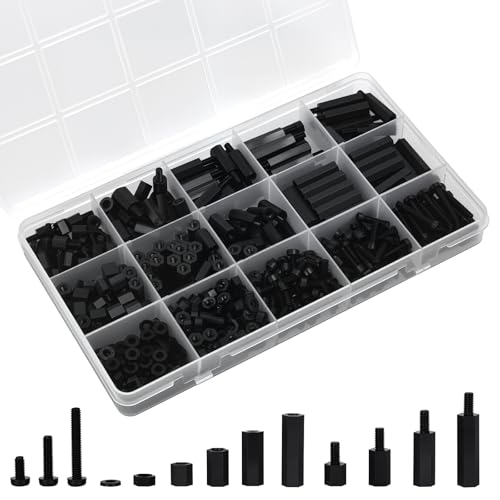 | Best Overall | Material: High-strength reinforced nylon | Piece Count: 600 pieces | Standoff Lengths: 6mm–20mm | CHECK ON AMAZON | Read Our Analysis |
| 350PCS M3 Black Nylon Hex Spacer Standoff Kit |  | Budget-Friendly Pick | Material: Nylon | Piece Count: 350 pieces | Standoff Lengths: Various sizes | CHECK ON AMAZON | Read Our Analysis |
More Details on Our Top Picks
M3 Nylon Standoff & Fastener Kit (600Pcs)
If you’re building computers, assembling drones, or working on PCB projects, you’ll find the M3 Nylon Standoff & Fastener Kit an essential solution for preventing electrical shorts and signal interference. This 600-piece kit includes threaded pillar standoffs, hex nuts, screws, and non-threaded spacers in lengths ranging from 6mm to 20mm, all pre-sorted in a compartmentalized storage box. The high-strength reinforced nylon construction is non-conductive and corrosion-proof, offering reliable insulation for sensitive electronics. You’ll appreciate the universal M3 standard compatibility across computers, 3D printers, industrial control panels, and Raspberry Pi projects. The precise manufacturing ensures perfect fit, while the organized storage system lets you locate any component in seconds.
- Material:High-strength reinforced nylon
- Piece Count:600 pieces
- Standoff Lengths:6mm–20mm
- Storage Organization:Heavy-duty, compartmentalized storage box
- Compatible Applications:Computers, 3D printers, drones, PCBs, Raspberry Pi projects
- Corrosion Resistance:Corrosion-proof
- Additional Feature:Prevents electrical shorts effectively
- Additional Feature:Non-conductive signal interference reduction
- Additional Feature:600-piece comprehensive assortment
350PCS M3 Black Nylon Hex Spacer Standoff Kit
The 350PCS M3 Black Nylon Hex Spacer Standoff Kit is your ideal solution when you’re working with sensitive electronic components that demand ESD protection. You’ll appreciate the thorough assembly featuring male-female hex spacers, standoffs, screws, and nuts in various sizes. The nylon construction offers lightweight durability with excellent resistance to wear, impact, and corrosion, making it perfect for electronic equipment, motherboards, and PCB boards. You can easily assemble and disassemble components using standard hex keys or screwdrivers, ensuring precise tightening and reliable connections. The sturdy plastic box with labeled compartments keeps everything organized and protected, whether you’re tackling robot projects, drones, or other precision applications requiring dependable fastening solutions.
- Material:Nylon
- Piece Count:350 pieces
- Standoff Lengths:Various sizes
- Storage Organization:Sturdy plastic box with labeled compartments
- Compatible Applications:Electronic equipment, computer motherboards, PCB boards, robots, drones
- Corrosion Resistance:High resistance to corrosion
- Additional Feature:Hex design secure grip
- Additional Feature:Easy assembly/disassembly capability
- Additional Feature:Male-female hex spacers included
Factors to Consider When Choosing an ESD-Safe Standoff Set That Mounts Boards Without Allowing Static Transfer
When you’re selecting an ESD-safe standoff set, you’ll need to evaluate the material composition and conductivity to guarantee proper static dissipation without compromising electrical safety. You must verify that the standoff’s voltage insulation ratings align with your circuit board’s requirements and that it’s compatible with relevant board standards like IPC specifications. Finally, you should assess the grounding and discharge prevention mechanisms alongside the product’s durability under repeated assembly cycles to guarantee long-term protection against electrostatic damage.
Material Composition And Conductivity
Selecting the right material composition for your ESD-safe standoff set requires understanding how nylon’s non-conductive properties protect your circuit boards from static discharge. High-strength reinforced nylon prevents electrical shorts between mounted components while reducing static transfer to sensitive circuits. You’ll appreciate nylon’s corrosion-proof nature, which guarantees long-term dielectric performance in electronics enclosures and racks. The material’s non-conductive design minimizes metal-to-metal contact paths that could trigger dielectric breakdown or unintended discharge events. Additionally, nylon offers excellent wear resistance and maintains stable dielectric behavior across typical electronics operating temperatures. This combination of durability and consistent insulation properties makes nylon standoff sets a reliable choice for protecting your equipment from ESD damage over extended periods.
Voltage Insulation Ratings Required
How do you know if your ESD-safe standoff set will actually protect your circuit boards? You’ll need to verify the voltage insulation rating, typically expressed as dielectric strength in kV/mm or total breakdown voltage in kilovolts. Nylon standoffs commonly offer 20–25 kV/mm, but thicker materials provide higher ratings. For ESD-sensitive applications, you’ll want breakdown voltage ratings well above expected transient voltages—ideally several kilovolts above your maximum exposure threshold.
Always check product specifications for explicit voltage ratings; unmarked standoffs aren’t suitable for ESD-safe mounting. Remember that environmental factors matter too. Higher humidity and elevated temperatures reduce effective insulation, potentially compromising your safety margin. Match your standoff’s rated voltage to your board’s protection requirements, accounting for real-world conditions where you’ll deploy them.
Compatibility With Board Standards
Compatibility with your PCB’s physical and electrical standards is essential for effective ESD protection and reliable mounting. You’ll want standoffs that feature universal M3 threads, which align with most common board configurations and mounting holes. Verify that the spacers accommodate your board’s thickness—typically 1.0–2.0 mm for standard PCBs—without creating gaps or bottoming out.
Check that nylon insulating material provides adequate electrical isolation between your board and chassis while maintaining mechanical stability. Confirm the kit’s hardware dimensions fit your mounting holes without interfering with nearby components or connectors. By ensuring these compatibility factors upfront, you’ll eliminate installation problems and guarantee your ESD-safe standoffs deliver both protection and secure board support.
Grounding And Discharge Prevention
Preventing static transfer through your PCB mounting requires careful attention to electrical isolation between the board and chassis. You’ll want to select nylon standoff sets because their non-conductive properties block charge migration between your PCB and mounting hardware. This insulation prevents static from finding an unintended path to ground.
Avoid metal spacers or metal-fastened mounts entirely—they create conductive pathways that enable discharge directly to your board. Instead, keep mounting hardware electrically isolated from any conductive enclosure. Your grounding strategy should rely on a dedicated dissipative path separate from your standoff components, supported by proper enclosure grounding. This dual approach guarantees you maintain discharge prevention while preserving effective grounding control across your assembly.
Durability Under Repeated Assembly
Since your PCB assembly process involves multiple mounting and disassembly cycles, you’ll need standoff sets built from high-strength reinforced nylon that resists wear far better than metal alternatives. Precision manufacturing and tight tolerances maintain consistent fit, preventing thread or spacer deformation after repeated use. Nylon’s low friction characteristics minimize wear on mating threads and standoffs during frequent mounting and disassembly, extending component lifespan considerably.
The material’s non-conductive properties eliminate galvanic wear and electrical interference that metal standoffs introduce through repeated contact cycles. Additionally, nylon’s corrosion-proof nature guarantees stable performance and structural integrity across countless assembly cycles in ESD-sensitive environments. This combination of durability and electrical safety makes reinforced nylon standoffs an ideal choice for demanding production applications requiring reliability without compromising electrostatic protection.
Storage Box Organization Systems
Proper component-storage architecture directly impacts your assembly workflow’s speed and accuracy. You’ll benefit from heavy-duty, compartmentalized boxes that pre-sort standoffs, spacers, and screws by size, enabling quick access during projects. Labeled compartments eliminate guesswork—you’ll instantly identify M3 spacers, standoffs, and nuts without rummaging through mixed contents.
Separating non-conductive nylon parts prevents cross-contamination and reduces component misplacement. Clear, resealable lids protect your inventory from dust and moisture while maintaining visibility of each compartment’s contents. This visibility streamlines your assembly process substantially.
An organized storage system directly enhances efficiency when assembling ESD-safe setups. You’ll retrieve corresponding sizes faster during both initial assembly and reassembly phases, minimizing downtime and project delays while maintaining component integrity.
Application-Specific Project Requirements
While organized storage keeps your components readily accessible, selecting the right ESD-safe standoff set for your specific project demands careful consideration of several technical factors. You’ll need to match standoff lengths and fastener sizes—typically M3 ranging from 6–20 mm—to your board’s thickness and mounting holes. Verify compatibility with universal M3 standards to guarantee precise fits without dangerous gaps that could cause flexing or shorting. Prioritize non-conductive nylon components that actively prevent static transfer between your board and mounting hardware. Choose materials offering both insulation and corrosion resistance, protecting against moisture and contaminants in demanding environments. These specifications directly impact your project’s reliability and your components’ safety from electrostatic damage.
Frequently Asked Questions
What Is the Difference Between Esd-Safe and Regular Standoffs?
You’ll find that ESD-safe standoffs dissipate static electricity safely, protecting sensitive electronics from damage. Regular standoffs don’t offer this protection, making them unsuitable for components vulnerable to electrostatic discharge. You’d choose ESD-safe for sensitive applications.
How Do I Know if a Standoff Set Is Truly Esd-Compliant?
You’ll verify ESD compliance by checking for certified documentation, examining surface resistance specifications (typically 10^5-10^9 ohms), and confirming manufacturer testing certifications like IEC 61340-5-1 standards compliance.
Can Esd-Safe Standoffs Be Reused Multiple Times Without Losing Effectiveness?
You can reuse ESD-safe standoffs multiple times without losing effectiveness if you maintain them properly. They won’t degrade from normal use, but you’ll need to inspect them regularly for damage and guarantee they’re cleaned to preserve their conductive properties.
What Temperature Range Can Esd-Safe Standoffs Safely Withstand?
You can safely use ESD-safe standoffs within temperature ranges of -40°C to 85°C, though premium models withstand -55°C to 125°C. You’ll want to verify your specific product’s rating since they’re not all identical.
Are Esd-Safe Standoffs Compatible With All PCB Materials and Designs?
You won’t find ESD-safe standoffs compatible with every PCB material and design. You’ll need to verify compatibility with your specific substrate, thickness, and component layout. You should always consult manufacturer specifications for your particular application.