
You’re facing a damaged PCB and need the right conductive epoxy to restore it properly. With so many options available, you’ll want to understand what separates a reliable repair from a failed one. The choice between fast-curing silver pastes and room-temperature adhesives can make or break your project. Let’s explore which formulations deliver the performance you actually need.
| Conductive Silver Paint for Electronics Repair |  | Quick-Dry Convenience | Curing Time: Quick drying; accelerates with heat | Volume/Package Size: 0.5 ml | Electrical Conductivity: Excellent conductivity | CHECK ON AMAZON | Read Our Analysis |
| JAOJAO Conductive Glue for Electronics (120ml) | 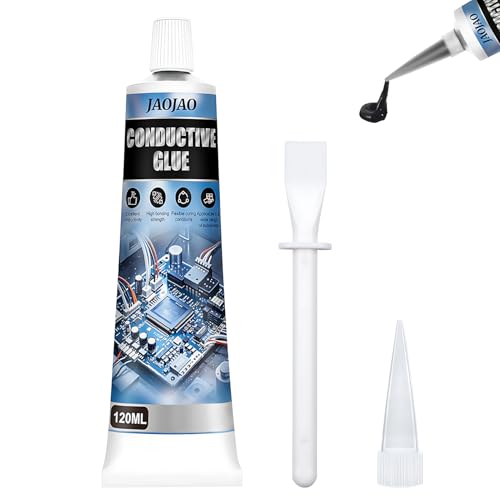 | Versatile Large Format | Curing Time: 24 hours at room temperature | Volume/Package Size: 120 ml | Electrical Conductivity: Conductive after curing | CHECK ON AMAZON | Read Our Analysis |
| Low Cost Conductive Silver Epoxy Adhesive Kit (2.5gm) | 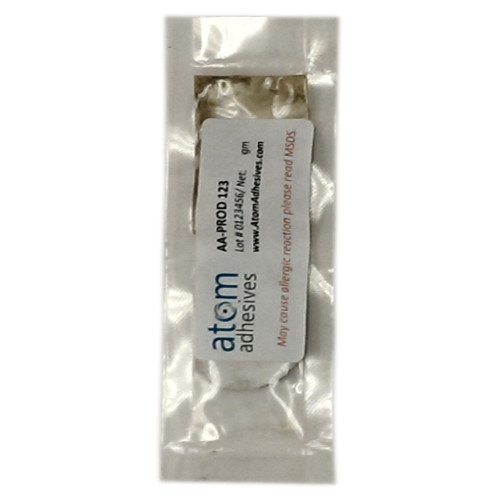 | Budget Starter Kit | Curing Time: 24 hours at room temperature | Volume/Package Size: 2.5 g | Electrical Conductivity: Electrically conductive | CHECK ON AMAZON | Read Our Analysis |
| Conductive Glue Circuit Board Adhesive 100ml Black |  | Best Value | Curing Time: 24 hours at room temperature; faster with heat | Volume/Package Size: 100 ml | Electrical Conductivity: High conductivity; optimal electrical conductivity | CHECK ON AMAZON | Read Our Analysis |
| MG Chemicals Silver Epoxy Adhesive with Dispensers (8331S) |  | Professional Grade | Curing Time: 2 hours at 65°C (heat required) | Volume/Package Size: 15 g with 2 dispensers | Electrical Conductivity: Good conductivity; 0.006 Ω·cm resistivity | CHECK ON AMAZON | Read Our Analysis |
More Details on Our Top Picks
Conductive Silver Paint for Electronics Repair
If you’re tackling circuit board repairs, conductive silver paint is your solution. This 0.5 ML silver conductive paste delivers excellent conductivity with quick-drying, low-temperature curing—perfect for CPUs, LED displays, and optical fiber equipment. You’ll benefit from exceptional electromagnetic shielding that protects sensitive components while resisting moisture and wear over time. The paint adheres strongly to multiple surfaces, making it ideal for keyboard PCB repairs and robust connections. Application’s straightforward: it dries fast, though you can accelerate the process with a hair dryer if needed. Durable performance ensures long-lasting results on your electronics repairs.
- Curing Time:Quick drying; accelerates with heat
- Volume/Package Size:0.5 ml
- Electrical Conductivity:Excellent conductivity
- Primary Applications:CPUs, LED displays, optical fiber, keyboard PCB repairs
- Environmental Durability:Resists wear and moisture
- Included Accessories:None mentioned
- Additional Feature:Hair dryer acceleration option
- Additional Feature:Multi-surface strong adhesion
- Additional Feature:Low-temperature curing capability
JAOJAO Conductive Glue for Electronics (120ml)
You’ll find JAOJAO Conductive Glue invaluable for circuit repairs, shielding connections, and electronics maintenance where you need both adhesive strength and electrical conductivity. This 120ml adhesive cures in 24 hours and creates waterproof, heat-resistant bonds that withstand vibrations and stress. You apply a thin 0.1–0.3mm layer to cleaned surfaces, ensuring complete coverage of connection points without gaps. It works excellently on PCB traces, LED arrays, flexible electronics, and solar panel electrodes. The package includes a scraper and matching accessories, making application straightforward. After curing, you’ll have a durable, conductive connection suitable for long-lasting repairs across diverse electronics projects.
- Curing Time:24 hours at room temperature
- Volume/Package Size:120 ml
- Electrical Conductivity:Conductive after curing
- Primary Applications:PCB traces, flexible electronics, LED arrays, solar panels
- Environmental Durability:Waterproof, heat-resistant, withstands vibration
- Included Accessories:Scraper included
- Additional Feature:Waterproof, heat-resistant bond
- Additional Feature:Flexible electronics compatible
- Additional Feature:Includes scraper tool
Low Cost Conductive Silver Epoxy Adhesive Kit (2.5gm)
The AA-DUCT 906 is your go-to choice for electronics repair work when you’re looking for an affordable, convenient solution. This single-use pouch kit contains 2.5 grams of low-cost, electrically conductive silver epoxy adhesive that you simply mix and apply directly in the packet. You’ll get a full hour of working time before it hardens at room temperature in 24 hours. It bonds effectively to glass, metals, fabrics, and wood, delivering unbeatable strength for most electronics applications. The product is REACH, RoHS, and conflict mineral compliant. If you need superior conductivity, consider upgrading to the AA-DUCT 902 instead.
- Curing Time:24 hours at room temperature
- Volume/Package Size:2.5 g
- Electrical Conductivity:Electrically conductive
- Primary Applications:General electronics applications
- Environmental Durability:Room temperature storage
- Included Accessories:Single-use pouch format
- Additional Feature:Single-use pouch convenience
- Additional Feature:Room temperature hardening
- Additional Feature:USA manufactured
Conductive Glue Circuit Board Adhesive 100ml Black
Electronics enthusiasts and professional technicians who need reliable circuit repairs will appreciate this 100ml black conductive adhesive’s ability to restore electrical connections while creating a durable bond that withstands vibration, heat, and moisture. You’ll benefit from room-temperature curing that completes in 24 hours, or faster with applied heat. The product’s smooth application, enhanced by included scraper and brush accessories, makes it ideal for repairing PCB traces, connecting LED chips, and addressing solar panel electrode issues. Its high conductivity after curing guarantees ideal electrical performance for shielding and contact repairs across various electronic components and flexible circuits.
- Curing Time:24 hours at room temperature; faster with heat
- Volume/Package Size:100 ml
- Electrical Conductivity:High conductivity; optimal electrical conductivity
- Primary Applications:Circuit boards, flexible circuits, LED chips, solar cells
- Environmental Durability:Resists vibration, heat, moisture
- Included Accessories:Scraper and pad included
- Additional Feature:Heat-accelerated curing option
- Additional Feature:Vibration and moisture resistant
- Additional Feature:Includes scraper and pad
MG Chemicals Silver Epoxy Adhesive with Dispensers (8331S)
For technicians who need to repair heat-sensitive PCB components without risking thermal damage, MG Chemicals’ 8331S silver epoxy offers an ideal solution. You’ll appreciate the straightforward 1:1 mix ratio and four-hour working window, giving you ample time for precise application. The two-part formula cures in just two hours at 65°C, making it efficient for production environments. With electrical resistivity of 0.006 Ω·cm and thermal conductivity of 1.3 W/(m·K), you’re getting excellent conductive properties. The adhesive handles continuous temperatures from -40 to 150°C, so your repairs withstand demanding conditions. Its convenient dispensers and room-temperature storage make handling hassle-free.
- Curing Time:2 hours at 65°C (heat required)
- Volume/Package Size:15 g with 2 dispensers
- Electrical Conductivity:Good conductivity; 0.006 Ω·cm resistivity
- Primary Applications:Electronic device bonding, conductivity seals, heat-sensitive materials
- Environmental Durability:Service temperature -40 to 150°C
- Included Accessories:2 dispensers included
- Additional Feature:Wide temperature service range
- Additional Feature:1:1 easy mix ratio
- Additional Feature:Dual dispenser packaging included
Factors to Consider When Choosing Conductive Epoxy That Bonds and Grounds at the Same Time on PCB Repairs
When you’re selecting a conductive epoxy that simultaneously bonds and grounds PCB components, you’ll need to evaluate several critical factors to guarantee best performance. You should prioritize electrical conductivity specifications, cure parameters, adhesion strength, environmental durability, and application ease to match your repair requirements and production constraints. Each of these elements directly impacts whether your repair will deliver reliable electrical connections and mechanical stability under real-world conditions.
Electrical Conductivity Requirements
The electrical properties of conductive epoxy determine whether you’ll achieve reliable bonding and grounding simultaneously on your PCB. You’ll want an adhesive exhibiting low electrical resistivity—ideally in the milliohm-centimeter range—to minimize voltage drop across the bond. Two-part, metal-filled formulations like silver-filled systems deliver superior bulk conductivity and reliable ground paths through their high filler content.
Remember that conductivity improves after curing, so you must allow full cure time before your connection becomes stable and low-resistance. You’ll also need continuous, gap-free coverage over connection points to prevent micro-gaps that raise resistance and disrupt grounding.
Finally, prioritize temperature and moisture resistance. You need your adhesive’s conductivity to remain stable under operating conditions, vibration, heat, and humidity.
Cure Time And Temperature
Achieving that low-resistance bond you’ve specified requires careful attention to how your epoxy cures, since incomplete curing directly undermines the conductivity you’ve worked to establish. Most conductive epoxies cure at room temperature, though working times vary from one to four hours depending on formulation. You’ll find cure times ranging from one hour to a full twenty-four hours before you can safely stress the joint. If you’re working under time constraints, consider elevated-temperature curing options—heating to sixty-five degrees Celsius accelerates full cure to approximately two hours. Don’t rush the process; premature stress causes higher resistance and compromised electrical performance. Always verify complete curing before applying operational load to your PCB repair.
Surface Adhesion Strength
Bonding conductive epoxy to your PCB components demands substrate compatibility as your foundation—you’ll want an adhesive that performs equally well on metals, glass, ceramics, and composite materials found throughout your circuit board. Strong surface adhesion guarantees your repairs remain durable through mechanical stress, thermal cycling, and environmental exposure. You’ll achieve maximum bond strength by preparing surfaces meticulously and applying uniform, gap-free layers. Room temperature curing works well for most repairs, though you can accelerate results with gentle heating when time’s critical. The adhesive’s resistance to moisture, vibration, and heat directly impacts long-term reliability. Proper application techniques—using scrapers or brushes for consistent coverage—optimize contact between epoxy and substrate, yielding robust connections that withstand operational demands and repeated thermal stress cycles.
Environmental Resistance Factors
Durability in harsh conditions separates reliable repairs from failures that’ll compromise your circuit board’s performance. You’ll want conductive epoxies that resist moisture and humidity, protecting your connections from corrosion and electrical degradation. Look for formulations rated across wide temperature ranges—from sub-zero to at least 150°C—ensuring stable conductivity through thermal cycling and seasonal fluctuations.
Vibration resistance matters too. Your repair must withstand mechanical stress and flexing without losing electrical integrity or bond strength. Choose epoxies with proven moisture resistance that maintain conductivity after prolonged exposure to environmental wear.
Higher thermal conductivity supports better heat dissipation near sensitive components, preventing thermal runaway. By selecting epoxies engineered for these environmental factors, you’re securing repairs that remain reliable throughout your PCB’s operational lifetime.
Application Method Ease
Successful PCB repairs depend on choosing a conductive epoxy that’s genuinely easy to apply. You’ll want a product that spreads into a thin, even 0.1–0.3 mm layer without pooling or trapping air around delicate traces. Look for kits that include scrapers or applicators—these tools help you create smooth, gap-free connections essential for reliable grounding.
Consider your working time carefully. Single-use pouches simplify handling and minimize waste, while longer pot lives give you flexibility when aligning shielding. Check whether the epoxy cures at room temperature or needs gentle heating to accelerate the process. You’ll want reliable bonding that withstands vibration, moisture, and thermal cycling, so verify the formulation delivers genuine conductivity after curing.
Long-Term Durability Performance
How long will your PCB repair actually hold up? You’ll want an epoxy that resists moisture and mechanical stress while maintaining conductivity through years of service. Look for formulations offering broad temperature ranges (-40°C to 150°C) that stabilize performance during thermal cycling. Two-part silver-filled systems deliver superior results, preserving low contact resistance and grounding integrity over time. Your cure method matters considerably—room-temperature cures over 24 hours or heat-assisted cures produce stronger, more durable bonds than fast-set alternatives. Choose epoxies specifically designed to withstand vibrations and dynamic environments, ensuring your grounding and shielding performance doesn’t degrade. This durability investment protects your circuit boards from premature failures and costly replacements.
Frequently Asked Questions
What Is the Shelf Life of Conductive Epoxy After Opening the Container?
You’ll typically have 3-6 months after opening your conductive epoxy, depending on the manufacturer and storage conditions. You should store it in an airtight container in a cool, dry place to maximize its usable lifespan and maintain its conductive properties.
Can Conductive Epoxy Be Used on Flexible Circuit Boards Without Cracking?
You can use conductive epoxy on flexible circuit boards, but you’ll need formulations specifically designed for flexibility. Standard epoxies crack under stress, so you’re looking for products with elastomeric additives that won’t fracture during board flexing.
How Long Does Conductive Epoxy Take to Cure at Room Temperature?
You’ll typically wait 24 hours for conductive epoxy to fully cure at room temperature, though it’ll reach initial set within 2-4 hours. Exact timing depends on your specific product’s formulation and ambient conditions.
Is Conductive Epoxy Safe to Use Around Sensitive Electronic Components?
You’ll find conductive epoxy safe around sensitive components when you apply it carefully and avoid contact with adjacent circuitry. You should use masking tape to protect nearby parts, and you’ve got to allow proper curing time before powering your device.
What Is the Electrical Conductivity Rating Compared to Solder Joints?
You’ll find conductive epoxy typically offers 1-10 ohms per square resistivity, while solder joints achieve 0.00001 ohms. Solder’s superior conductivity makes it preferable for high-current applications, though epoxy works adequately for low-power repairs.

Leave a Reply