
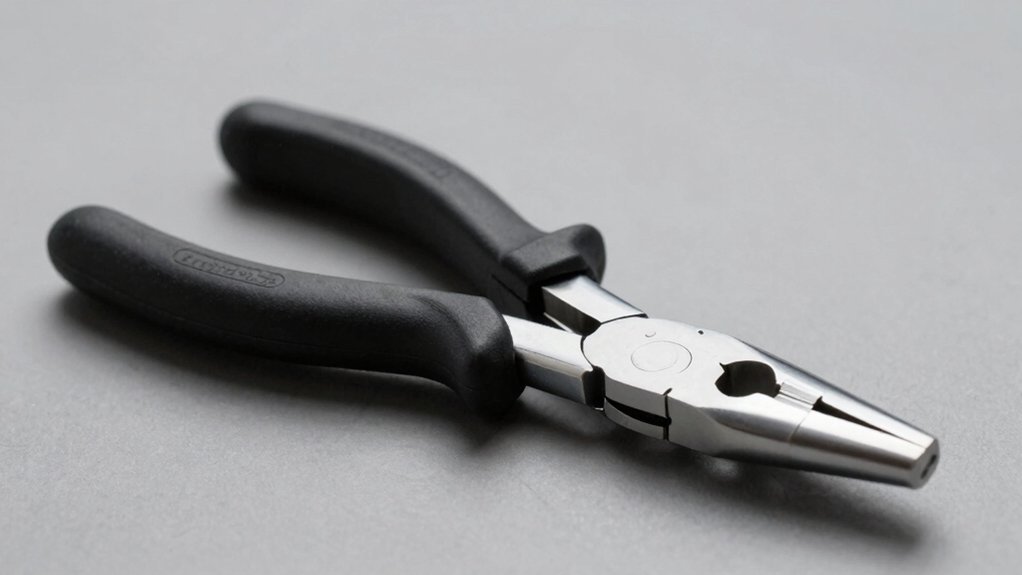
You’re working on intricate circuit boards and delicate components when your standard pliers slip—damaging expensive equipment and derailing your project timeline. What if you could reach into confined spaces with precision while maintaining complete electrostatic safety? The right ESD-safe long-nose pliers aren’t just tools; they’re investments in both your work quality and component protection. Let’s explore what separates the standout options from the rest.
| ENGINEER Precision Mini Long Nose Pliers (PS-03) |  | Best Overall | Jaw Type: Carbon steel, non-serrated, half-round | Length: 141 mm | Handle Material: Oil-resistant thermoplastic elastomer | CHECK ON AMAZON | Read Our Analysis |
More Details on Our Top Picks
ENGINEER Precision Mini Long Nose Pliers (PS-03)
If you’re working with delicate electronics or precision PCB components, you’ll appreciate the ENGINEER Precision Mini Long Nose Pliers (PS-03)—they’re specifically engineered for tasks where static discharge can damage sensitive circuitry. These Japanese-made pliers feature ESD-safe construction with carbon steel, non-serrated half-round jaws and a fine needle tip for exceptional control. At 141mm long and weighing just 81 grams, they’re compact enough for intricate work. The oil-resistant thermoplastic elastomer grips combined with spring-loaded handles reduce hand fatigue during extended use. RoHS compliant and backed by Amazon’s 30-day return guarantee, they’re still actively manufactured and widely available for electronics professionals and hobbyists alike.
- Jaw Type:Carbon steel, non-serrated, half-round
- Length:141 mm
- Handle Material:Oil-resistant thermoplastic elastomer
- Weight:81 grams
- Primary Applications:Electronics, PCB work, precision crafts
- Certifications:RoHS compliant, ESD-safe
- Additional Feature:Fine needle tip design
- Additional Feature:Spring-loaded handles
- Additional Feature:Half-round carbon steel jaws
Factors to Consider When Choosing ESD-Safe Long-Nose Pliers That Reach Deep Into Chassis Without Risk
When you’re selecting ESD-safe long-nose pliers for deep chassis work, you’ll want to prioritize jaw length and reach to access confined spaces without compromising your components’ safety. You should verify that your chosen pliers meet established ESD protection standards while offering material quality and durability that’ll withstand repeated precision tasks. You’ll also benefit from evaluating grip comfort for steady control and considering spring-loaded handles, which reduce hand fatigue during extended use and enhance your overall work efficiency.
Jaw Length And Reach
How deep can you reach into a chassis without compromising component safety? Jaw length directly determines your access depth and precision. A 141 mm total length gives you extended reach into confined spaces where standard pliers won’t fit. The fine needle tip penetrates tight recesses, letting you access distant components with minimal contact area. Non-serrated, half-round carbon steel jaws navigate around obstructions smoothly, preventing unnecessary touching of surrounding circuitry. Long-nose geometry prioritizes depth reach over grip width, making it ideal for deep chassis work. When working with ESD-sensitive areas, this extended reach becomes essential—you can manipulate components from safer distances, reducing static discharge risk while maintaining the control you need in tight quarters.
Esd Protection Standards
Beyond selecting the right jaw length for deep reach, you’ll need to verify the ESD protection standards that govern your tool’s safety rating. Look for pliers explicitly certified to IEC or ANSI ESD standards, which establish measurable dissipation rates for static electricity. While product labels mentioning “ESD-safe” and RoHS compliance indicate basic safety considerations, they don’t guarantee specific standard compliance without detailed certification documentation.
Verify that your pliers feature continuous dissipative paths through handles and grips—this design guarantees charge flows safely away from sensitive components rather than accumulating. Request specification sheets detailing exact resistance measurements and test results. Don’t assume labeling alone proves adequate protection; confirm third-party testing validates the tool meets your industry’s required ESD standards before purchasing.
Material Quality And Durability
The durability of your ESD-safe long-nose pliers directly impacts both their lifespan and your protection against static discharge during repeated use. You’ll want alloy or carbon steel construction with carbon steel jaws that resist wear through countless applications. Fine needle tips and non-serrated, half-round jaws preserve tip geometry, preventing edge degradation that compromises precision work inside delicate chassis.
Quality grips matter too. Oil-resistant thermoplastic elastomer handles minimize fatigue and degradation, keeping your tools comfortable and functional over extended periods. Spring-loaded mechanisms reduce strain on your hands while maintaining consistent performance.
Finally, verify RoHS compliance. This certification confirms the absence of restricted substances, ensuring your pliers maintain reliability and won’t introduce contaminants near sensitive components. These material standards collectively guarantee long-term durability and consistent ESD protection.
Grip Comfort For Precision
While durable materials form the foundation of reliable ESD-safe pliers, you’ll also need a grip that supports precision work without causing hand strain during extended use in confined spaces. Look for ergonomic grip shaping that enables fine fingertip control and steady pressure when reaching into tight chassis openings. Oil-resistant thermoplastic elastomer reduces slipping while enhancing tactile comfort, so you maintain control without excessive grip force. Spring-loaded handles automatically return to position, minimizing hand fatigue and supporting steadier, more precise operation. A lightweight design around 81 grams reduces hand effort during delicate maneuvers. These grip features work together to deliver comfortable, controlled handling that protects both your equipment and your hands.
Spring-Loaded Handle Benefits
Automating the grip reset through spring-loaded handles transforms your workflow when you’re working deep inside confined chassis spaces. You’ll experience faster repetitive operations since the tool automatically reopens after each squeeze, eliminating manual resets that drain your energy during extended electronics and PCB work.
This feature enables genuine one-handed operation, letting you position the needle tip into tight areas while your other hand manages components or positioning. You’ll maintain steadier control during delicate precision tasks because the consistent grip release reduces muscle compensation and hand strain.
The spring mechanism supports accurate needle placement in recessed spots where tremor or fatigue typically compromises accuracy. By minimizing the physical demand of manually resetting your grip, you’ll work longer with greater precision and less finger fatigue.
Non-Serrated Tip Design
How do you protect delicate components when maneuvering deep into confined chassis spaces? Non-serrated tips deliver the answer. Unlike serrated designs, smooth jaws make precise contact without marring sensitive parts, especially when reaching into tight recesses. The fine needle tip enables exact alignment and manipulation in cramped areas where accuracy matters most.
You’ll appreciate how non-serrated, half-round jaws glide past wiring bundles without snagging, guiding your tool safely through complex internal layouts. The smooth surface reduces slippage on small components, giving you controlled force application during intricate electronic tasks.
When combined with ESD-safe materials, non-serrated tips minimize unintended contact points and static discharge risk in restricted workspaces. This design choice protects both your equipment and components from damage.
Weight And Control Balance
Finding the right weight for your ESD-safe long-nose pliers fundamentally shapes your ability to work safely in confined spaces. At 141 mm in length and approximately 81 g, quality long-nose pliers strike an ideal balance between reach and control. You’ll want lighter tools to reduce hand fatigue during extended sessions, but don’t sacrifice leverage and precision in tight areas. Spring-loaded handles maintain consistent grip tension, enhancing control during delicate movements near sensitive components. Conversely, excessive handle mass increases inertia, compromising fine motor control during precise tip work. Weight distribution toward the tips influences stability and alignment when reaching deep into confined areas. Prioritize tools that distribute weight evenly while remaining light enough for steady, controlled operation.
Frequently Asked Questions
How Often Should Esd-Safe Pliers Be Recalibrated or Tested for Safety?
You should test your ESD-safe pliers annually or per manufacturer guidelines. You’ll want to verify their electrical resistance regularly, especially if you’re using them in high-static environments. Regular testing guarantees they’re protecting your components effectively.
What Is the Typical Lifespan of Esd-Safe Long-Nose Pliers Before Replacement?
You’ll typically get 5-10 years of reliable use from quality ESD-safe long-nose pliers with proper maintenance. However, you should replace them sooner if you notice handle damage, reduced spring tension, or failed electrical resistance testing.
Are Esd-Safe Pliers Suitable for Use in Humid or Wet Environments?
You shouldn’t use ESD-safe pliers in humid or wet environments because moisture compromises their static-dissipative properties. You’ll want to keep them dry and store them in controlled conditions to maintain their effectiveness.
Can Esd-Safe Pliers Be Used Interchangeably With Standard Non-Esd Pliers?
You can’t use ESD-safe pliers interchangeably with standard pliers. You’ll need ESD-safe tools in electrostatic-sensitive environments to prevent component damage. Standard pliers lack the static-dissipative properties you’ll require for electronics work.
What Certifications Should I Verify When Purchasing Esd-Safe Long-Nose Pliers?
You’ll want to verify ISO 9001 certification, ESD Association standards (ANSI/ESD S20.20), and resistance ratings. You should also check for grounding compliance documentation and third-party testing verification to guarantee your pliers meet industry safety requirements.


Leave a Reply