
If you’re setting up an electronics bench, the right ESD mat can make a bigger difference than you might expect. You’ll find roll-style covers, portable kits, and compact pads, each with different strengths in durability, grounding, and heat resistance. Some are built for full workbench coverage, while others fit repair jobs on the move. The question is which one actually matches your workspace and the way you work?


Product availability last checked: October 2026
Which ESD Mat Fits Your Bench?
- Good to know first: an ESD mat only works when it is grounded. Mat rolls usually come without a grounding cord.
- Long benches: rolls you cut to length: 23.6 inch x 10 ft roll, Pangda or CDIWULDN.
- A standard 4 to 5 ft bench: LUTICO 24 x 48 with grounding kit or 30 x 60 rubber soldering mat.
- PC builds and repairs on the go: LUTICO 24 x 24 portable kit or iFixit portable mat.
Which Mat Covers Your Bench?
Measure the part of the bench you work on.
You need a mat about –.
| Mat | Size | Fit | |
|---|---|---|---|
| 23.6 inch roll | 23.6 x 118 in | – | View on Amazon |
| Pangda roll | 30 x 120 in | – | View on Amazon |
| CDIWULDN roll | 30 x 120 in | – | View on Amazon |
| LUTICO kit | 24 x 48 in | – | View on Amazon |
| Rubber soldering mat | 30 x 60 in | – | View on Amazon |
| LUTICO portable | 24 x 24 in | – | View on Amazon |
Rolls can be cut to length. A mat a little smaller than the bench is fine, as long as it covers where you handle parts.
More Details on Our Top Picks
Hexawit ESD Anti-Static Soldering Mat Roll 23.6″ x 118″ Green
If you want a versatile ESD mat roll, this one stands out as the overall pick. You get a 23.6″ x 118″ green rubber mat that dissipates static fast, with decay time at or below 0.1 seconds. Its double-layer build pairs a static-dissipative top with a conductive bottom, so you protect boards, phones, PCs, and tablets from ESD damage. You can trim it for custom bench setups, and it resists soldering heat, flux, oils, and solvents. It also handles up to 500°F, so you can work confidently in shops, labs, or home studios.
- Type:Soldering mat roll
- Size:23.6″ x 118″
- Color:Green
- Material:Rubber
- Thickness:0.08″
- Grounding:Not specified
- Additional Feature:Instant static dissipation
- Additional Feature:Oil and solvent resistant
- Additional Feature:Trim-to-fit customization
Not ideal if you want a grounding kit included. It is a mat roll; buy a grounding cord separately.
Pangda ESD Mat Roll 2.5x10ft Heat Resistant Anti-Static Soldering Mat Blue
Pangda’s 2.5x10ft ESD mat roll suits you when you need coverage for large workspaces. You get upgraded pure natural rubber, so it’s flexible, durable, low-odor, and built to last. The two-layer design pairs a static-dissipative gray top with a conductive black base, helping charges dissipate within 0.5 seconds when grounded. You can cut it to fit your bench, and the textured surface keeps tools from slipping. It resists oil, solvents, hot solder, and brief iron contact, making it a smart pick for repair, PCB, and soldering tasks.
- Type:ESD mat roll
- Size:2.5′ x 10′
- Color:Blue
- Material:Natural rubber
- Thickness:0.08″
- Grounding:Requires grounding
- Additional Feature:Textured non-slip surface
- Additional Feature:Low-odor natural rubber
- Additional Feature:Static release in 0.5s
Not ideal if you need it right away. Stock was limited when we last checked.
CDIWULDN ESD Anti-Static Workbench Mat Roll
CDIWULDN’s 2-layer mat roll delivers strong value for busy electronics workbenches. You get a 0.08-inch rubber surface that stands up to soldering heat, oil, grease, and solvents, so you can keep your bench clean and ready. Its static-dissipative top layer and conductive base help drain charge in about 0.5 seconds, protecting sensitive parts while you work. With resistance ratings that support reliable ESD control, it works well once you ground it with a standard cord. The 2.5 x 10-foot roll cuts easily for repair shops, labs, and PC builds.
- Type:Workbench mat roll
- Size:2.5′ x 10′
- Color:Not specified
- Material:Rubber
- Thickness:0.08″
- Grounding:Requires grounding cord
- Additional Feature:High-temperature solder resistant
- Additional Feature:Easy-clean work surface
- Additional Feature:Standard grounding cord compatible
Not ideal if you want a grounding kit included. It is a mat roll only.
LUTICO Anti Static ESD Mat for Electronics Repair 24″X48″ Grounding Kit
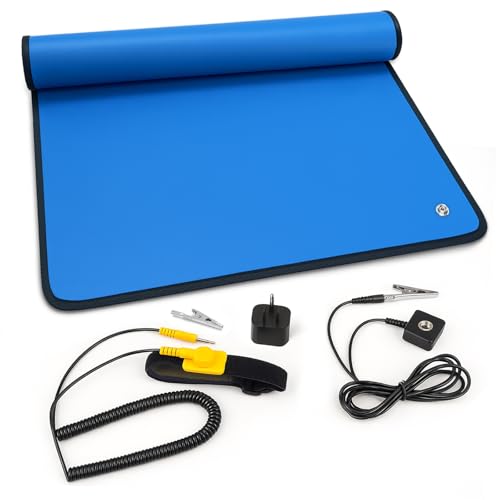
For newcomers setting up an electronics repair bench, this 24″ x 48″ ESD mat makes a solid starter kit. You get a professional-grade, blue-and-black composite surface that dissipates static fast, with surface resistivity rated at 10^6 to 10^8 ohms and volume resistivity at 10^5 to 10^8 ohms. The 24 x 48 x 0.08-inch size gives you plenty of room for PC, tablet, board, and phone repairs. The grounding kit includes a wrist strap, coil cord, and common-point ground cord with ring terminal, though you’ll need your own outlet adapter.
- Type:ESD mat
- Size:24″ x 48″
- Color:Blue
- Material:Composite
- Thickness:0.08″
- Grounding:Includes grounding kit
- Additional Feature:Grounding kit included
- Additional Feature:Multi-layer composite structure
- Additional Feature:Repairs PCs and tablets
Not ideal if your bench is longer than 4 ft. It is 24 x 48 inches.
Scientific Americas Rubber ESD Anti-Static Soldering Mat with Ground Cable
If you need a heavy-duty pick, this blue 30″ x 60″ ESD soldering mat handles serious bench work. You get a 0.08″ thick rubber mat with a ground cable, so you can protect boards while keeping static under control. Its two-layer build combines a 0.5mm static-dissipative top and a 1.5mm conductive bottom for reliable RTT, RTG, and surface resistance performance. You can also solder confidently because it withstands 600°F for 10 seconds without melting or odor. Scientific Americas makes it for tough, chemical-resistant, long-lasting bench use.
- Type:Soldering mat
- Size:30″ x 60″
- Color:Blue
- Material:Rubber
- Thickness:0.08″
- Grounding:Includes ground cable
- Additional Feature:Withstands 600°F heat
- Additional Feature:Long-lasting wear resistance
- Additional Feature:Superior chemical resistance
Not ideal if your bench is under 5 ft wide. It is 30 x 60 inches.
LUTICO Portable Anti Static ESD Mat Kit 24″X24″ PC Building & Electronics Repair
LUTICO’s 24″ x 24″ portable ESD mat kit suits beginners tackling PC builds and quick electronics repairs. You can use it for GPU, RAM, SSD, and power supply swaps, plus laptop, phone, and classroom projects. The static-dissipative mat helps slowly release charge, lowering ESD risk while you handle parts. You get a wrist strap, grounding hub, cord, alligator clip, and plug, so setup stays simple. Its foldable design fits a backpack or tool bag. Expect light creases and a mild odor that fade quickly.
- Type:Portable mat kit
- Size:24″ x 24″
- Color:Blue
- Material:Mat material
- Thickness:Not specified
- Grounding:Includes grounding kit
- Additional Feature:Complete grounding kit
- Additional Feature:Foldable travel-friendly design
- Additional Feature:Visual setup guides
Not ideal if you need to cover a full bench. It is a 24 x 24 inch portable mat.
iFixit Portable Anti-Static Mat – ESD Pad Wrist Strap Grounding Cord
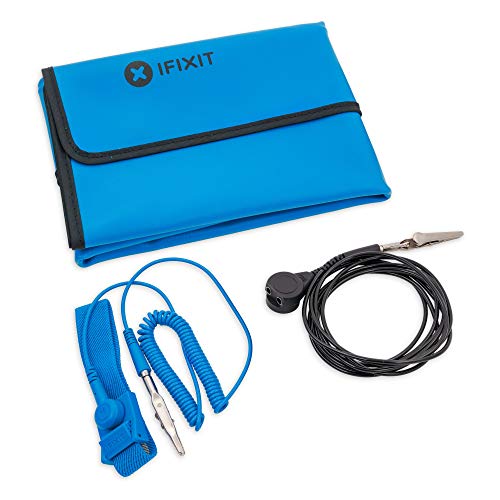
iFixit’s portable anti-static mat is the most portable pick for mobile repair work. You get an ESD pad, adjustable wrist strap, and grounding cord in one compact kit, so you can protect phones, tablets, computers, and other sensitive gear anywhere you repair. The foldable 60 cm by 60 cm mat travels easily, while its 10^7 to 10^9 ohm surface resistivity helps limit static buildup. Connect it to a ground source, wear the strap, and place parts on the black mat. It’s a smart choice for hobbyists and professional engineers alike.
- Type:Portable anti-static mat
- Size:60 cm x 60 cm
- Color:Black
- Material:ESD pad material
- Thickness:Not specified
- Grounding:Includes grounding cord
- Additional Feature:Adjustable XL wrist strap
- Additional Feature:1.8-meter grounding cord
- Additional Feature:10 mm grounding snap
Not ideal if you need a permanent bench cover. It is a portable mat for repairs on the go.
What Else You Will Need

Grounds the mat and a wrist strap to one point.


Normal cleaners can leave a film that stops the mat working.
Factors to Consider When Choosing ESD Workbench Covers and Mats
When you choose an ESD workbench cover or mat, start by checking material durability and how well it holds up to daily use. You’ll also want to compare static dissipation rates, grounding compatibility, heat resistance, and the mat size options that fit your workspace. These factors help you pick a mat that protects your gear and works smoothly on your bench.
Material Durability
Durability matters because your ESD workbench cover or mat has to handle daily wear without losing protection. You should look for premium natural or synthetic rubber, since it resists heat, oil, grease, and solvents in busy electronics spaces. A 0.08-inch thickness usually gives you strong wear resistance and lets the mat tolerate soldering-iron temperatures up to 500–600°F without deforming or melting. Double-layer construction adds staying power too: the static-dissipative top layer and conductive bottom layer work together over long service life. When the surface stays intact, you can clean it easily and avoid wear that could weaken protection. If your bench size varies, choose a flexible mat you can trim without sacrificing strength, fit, or performance.
Static Dissipation Rates
Once you’ve chosen a mat that can stand up to daily wear, check how fast it neutralizes static charges. You want a cover or mat that dissipates static quickly, usually in fractions of a second. Strong options clear charge in about 0.1 to 0.5 seconds, which helps shield sensitive components while you handle or assemble them. If the rate is slow, you raise the chance of an electrostatic discharge event. That speed ties closely to surface resistance, which usually falls between 10^6 and 10^9 ohms. When you pick a mat with consistent dissipation, you keep your workspace more controlled and your repairs safer. Fast, reliable performance matters every time you place, move, or test electronics.
Grounding Compatibility
Grounding compatibility is what turns an anti-static mat from a surface protector into a true ESD safeguard, because it gives static electricity a safe path away from sensitive components. You should choose mats with a conductive base layer and connect them to earth ground with a grounding cord or kit. Look for grounding snaps or rings, since they let you attach wrist straps or cords quickly and keep the setup consistently bonded. If you skip grounding, the mat may only spread charge across its surface, leaving your parts exposed to sudden discharge during soldering or assembly. Check the grounding path regularly, too. You want continuity and low resistance from the mat to earth ground, so your workstation keeps protecting components every time you handle them.
Heat Resistance
After you’ve confirmed the mat is properly grounded, the next thing to check is heat resistance, especially if your bench sees regular soldering work. You need a mat that can handle soldering iron temperatures up to 500°F without warping, softening, or giving off odors. That matters because you’ll often set hot tools down briefly, then return to them repeatedly during repairs. Strong heat resistance also helps the surface shrug off flux, solder splashes, and other high-temperature wear, which can shorten a mat’s life. Choose a model with documented heat resistance ratings so you know it’ll protect your work surface and sensitive components. A mat that keeps its shape and surface properties under heat will also keep dissipating static effectively, job after job.
Mat Size Options
When you’re choosing an ESD mat, size should match the way you actually work: compact mats are easy to carry for field repairs or small benches, while larger mats are better for full workstations and industrial setups. You should cover the entire area where you repair, assemble, or solder electronics, because gaps reduce protection and can force you to move parts around. Small mats, like 24″ x 24″ options, work well when space is tight. Larger mats and rolls, including lengths over 23″ x 100″, let you trim a custom fit or cut several mats from one roll. If you keep tools, components, and devices on the surface, choose extra room so you can work efficiently without constant repositioning.
Surface Texture
Surface texture can make a bigger difference than you might expect, because a slightly textured ESD mat reduces glare and helps you see tiny components and solder points more clearly. That matters when you’re placing parts, checking joints, or aligning tools. A lightly textured surface also gives small components and drivers more grip, so they’re less likely to slide off your bench. You’ll value that extra control when you’re working on delicate assemblies. Many mats use a top static-dissipative layer with a texture that balances secure contact with easy handling. This helps keep workpieces steady, minimizes accidental movement, and supports consistent static dissipation while you work. Choose a texture that feels stable without getting in the way.
Chemical Resistance
Chemical resistance matters because your ESD mat should stand up to oils, greases, flux, and solvents without breaking down. When you choose a mat with strong resistance, you protect its surface from damage that can weaken static dissipation and shorten service life. Look for natural rubber or upgraded rubber composites, since they usually handle soldering flux and cleaning agents better than basic materials. If you work around hot solder, pick a mat that pairs chemical resistance with heat resistance so it won’t warp or give off odors. A durable, chemical-resistant surface also makes cleanup easier after repairs, letting you wipe away residue quickly and keep your bench ready for the next job. That durability pays off every day.
Portability Features
If you move between benches, field repairs, or temporary setup areas, portability can matter just as much as durability. You’ll want a mat that folds or rolls so you can slip it into a backpack or tool bag without hassle. Lightweight construction makes it easier to carry between workstations or remote job sites, while smaller sizes like 24″ x 24″ still give you a useful protected surface. Look for compact kits that include wrist straps and grounding cords, since they save space and keep you ready for quick repairs or assembly. Clear grounding instructions also help you deploy the mat fast, so you can set up static protection wherever you work and get back to the task without delays.
Frequently Asked Questions
How Often Should ESD Mats Be Tested for Conductivity?
You should test your ESD mats for conductivity at least every 6 to 12 months, and after spills, damage, or cleaning. You’ll catch wear early and keep your workstation safely grounded.
Can ESD Mats Be Cleaned With Regular Household Cleaners?
No, you shouldn’t use regular household cleaners on ESD mats; they can leave insulating residue. You should use manufacturer-approved cleaners or mild soap and water, then dry them thoroughly to preserve static-dissipative performance.
Do Thicker ESD Mats Provide Better Static Protection?
Not necessarily; you’ll get better cushioning and durability, but thickness alone doesn’t improve protection. You need proper surface resistivity, grounding, and contact quality, so choose a mat that fits your work and handling needs.
Are ESD Mats Safe to Use With Hot Soldering Irons?
Yes, you can use ESD mats with hot soldering irons if you keep the iron on a proper stand and avoid direct contact; otherwise, you’ll scorch the mat and damage its dissipative surface.
How Do I Know if My Workbench Needs a Mat or a Cover?
You need a mat or cover if you handle electronics, static-sensitive parts, or soldering; if your bench scratches, stains, or heats up, one helps. If you mostly do general repairs, you probably don’t need one.