
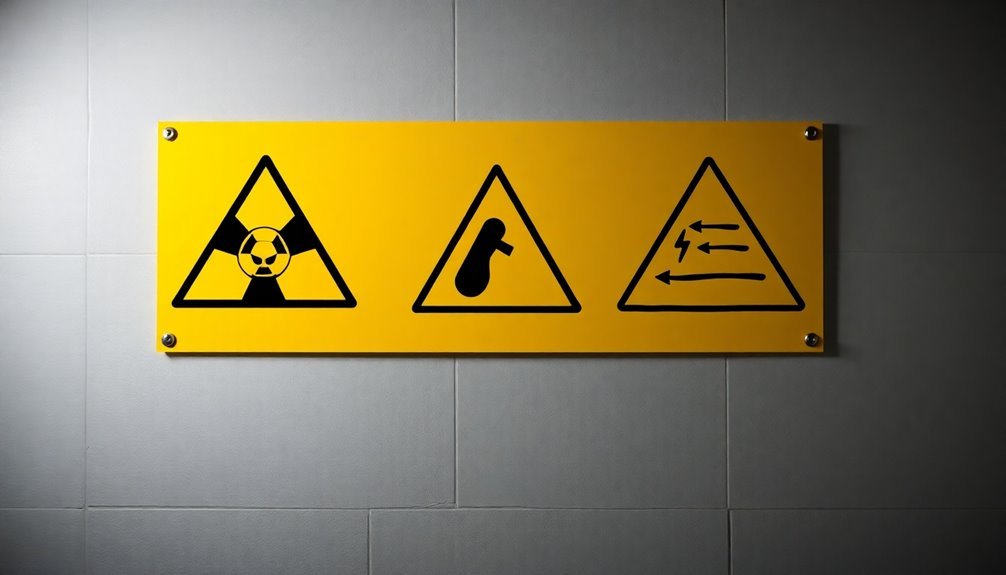
ANSI Z535 standards require specific colors, symbols, and text formatting for static warning signs. You'll need to use orange backgrounds with black lettering for warning signs indicating energized equipment hazards. Mount signs 5-7 feet high in clear view of hazards, using durable materials like aluminum composite or vinyl that withstand temperatures from -40°F to +180°F. Include appropriate signal words (DANGER, WARNING, CAUTION) and guarantee text remains legible from 5 feet away. Regular inspections and maintenance keep signs compliant. Understanding the complete ANSI Z535 requirements will help you create effective, long-lasting safety signage for your facility.
Basic ANSI Z535 Requirements
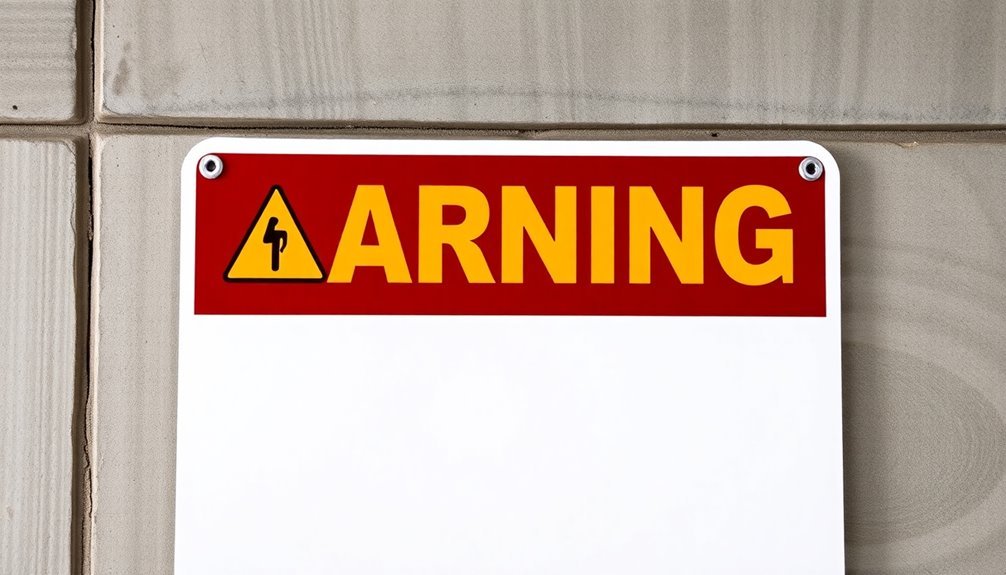
In accordance with workplace safety standards, ANSI Z535 establishes a thorough six-part framework for safety signage and labeling. As you implement these standards, you'll need to follow guidelines covering safety colors, environmental signs, safety symbols, product labels, safety tags, and barricade tapes.
The standard aligns with ISO 3864 requirements, confirming your signs meet international specifications. Regular maintenance and inspections ensure signs remain readable and effective.
You'll encounter four main symbol categories in your safety signage: hazard alerting, mandatory action, prohibition, and informational. When designing your signs, you must use simple, easy-to-understand symbols that reinforce written messages. You'll need to incorporate specific signal words like DANGER, WARNING, CAUTION, and NOTICE to indicate different hazard levels.
Your signs must be durable enough to withstand harsh environments, chemicals, and extreme temperatures. Remember to place warning signs where workers will encounter hazards during operation or maintenance.
While ANSI Z535 isn't legally enforced, it's widely adopted across industries and updated every five years to maintain effectiveness. The most recent revision occurred in 2017, so you should confirm your signage meets these current requirements.
Warning Sign Color Standards
When implementing ANSI Z535.1 warning signs, you'll need to follow strict color standards that assign specific meanings to each safety color. For warning signs specifically, you must use safety orange backgrounds with black lettering to indicate energized machines or equipment hazards. Safety Color Charts provide clear formulations and Pantone numbers for precise color matching.
Each safety color serves a distinct purpose in hazard communication. While orange denotes warnings, red signals danger and fire safety equipment, yellow indicates caution for physical hazards, green marks first aid locations and safety information, and blue is reserved for property policies and general facility information.
To maintain compliance, you must verify your warning signs meet precise color specifications defined by Munsell notations and CIE colorimetric data. The orange color you use shouldn't be confused with yellowish or reddish variations, as color distinction is vital for effective hazard recognition.
These standards align with ISO 3864 requirements, supporting global compliance in your hazard communication efforts.
Remember that OSHA has adopted these ANSI color codes, making them mandatory for workplace safety signage. You'll need to maintain consistent application across all your facility's equipment and hazard warnings to facilitate effective communication.
Static Electricity Symbol Guidelines

When you're creating ANSI-compliant static warning signs, you'll need to incorporate standardized ESD symbols that feature either a yellow hand in a black triangle for susceptibility or a bold arc around the triangle for protective measures.
Your signs must follow ANSI S8.1:2012 specifications for symbol design, ensuring proper proportions and clear visibility for both the ESD Susceptibility and ESD Protective symbols.
The symbols should be prominently displayed on your warning signs alongside the appropriate signal word "NOTICE," with careful attention to size requirements that allow visibility from the intended viewing distance. These warning signs must be made with UV-resistant materials to maintain durability and readability over time.
Symbol Design Standards
Static electricity warning symbols follow strict design requirements established by ANSI S8.1:2012 and ANSI/ESD S20.20:2007 standards for U.S. applications, with international equivalency provided by IEC 61340-5-1. You'll need to verify your symbols meet these standards when marking ESD-sensitive components or protective areas.
When designing ESD warning signs, you'll use specific symbols: a reaching hand in a triangle with an arc for protective items, and a yellow hand in a black triangle with a slash for sensitive components. Wrist straps and grounding must be used when handling these marked components.
You can add letter codes beneath the triangle to identify specific ESD control properties – 'L' for Low Charging, 'D' for Static Dissipative, and 'C' for Conductive EPA.
You must avoid using red in your symbols, as it implies personnel hazards. Instead, incorporate the signal word "NOTICE" to indicate potential equipment damage, following ANSI Z535 guidelines.
For common ground points, you'll use concentric circles with a thick outer circle to mark where ground wires should connect.
Remember that IEC 61340-5-3 provides additional letter codes for protective packaging materials: 'S' for shielding, 'F' for field shielding, 'C' for conductive, and 'D' for dissipative.
Placement and Size Rules
Proper placement and sizing of static electricity warning signs directly impacts their effectiveness in protecting sensitive equipment and personnel. You'll need to position signs where they're easily visible to workers entering ESD-sensitive areas, ensuring they don't create obstacles in the workspace. The signs must be clearly viewable from a reasonable distance, typically 5 feet, and placed near specific equipment requiring grounding. Adhering to military standard MIL-STD-1686 remains crucial for contractors and suppliers working on military projects.
| Aspect | Requirement | Standard |
|---|---|---|
| Location | Easily visible entry points | ANSI Z535.4 |
| Size | Readable from 5 feet | ANSI minimum standards |
| Color | High-visibility (yellow/orange/red) | Safety color codes |
| Signal Words | "NOTICE" for ESD hazards | ANSI Z535.4 |
| Text Format | Clear, legible fonts | Size-to-distance ratio |
When mounting your signs, you'll want to maintain proper clearance from other objects and equipment. The sign's dimensions should follow ANSI standards, with symbols large enough for clear visibility. Don't forget to include essential information like grounding points, inspection dates, and specific safety instructions. Make sure your signs use appropriate signal words and incorporate the standard ESD symbol to effectively communicate hazards to workers.
Sign Materials and Durability
When selecting materials for ANSI-compliant static warning signs, you'll need to choose from aluminum composite, plastic, or vinyl labels that meet specific durability requirements.
Your sign must withstand UV exposure, chemicals, abrasion, and moisture while remaining readable across temperatures from -40°F to +180°F. Signs feature permanent adhesive backing for secure installation.
To guarantee compliance with ANSI Z535 standards, you'll want to verify that your chosen material has passed appropriate durability testing and maintains its integrity for the expected service life, which can be up to 10 years for aluminum composite signs.
Material Selection Basics
Selecting the right material for warning signs is essential for ensuring their effectiveness and longevity. You'll need to evaluate several factors when choosing your sign material, including environmental exposure, service temperatures, and potential contact with corrosive substances.
| Material Type | Best For | Key Features |
|---|---|---|
| AL-Plus & PVC | General Use | 3mm aluminum composite or 1mm semi-rigid plastic, mounting holes included |
| Fiberglass | Harsh Environments | Up to 25-year lifespan, extreme durability, chemical resistant |
| Adhesive Vinyl | Quick Application | Self-adhesive backing, flexible, good for smooth surfaces |
For outdoor applications, you'll want to use materials that can withstand UV exposure and varying weather conditions. Fiberglass signs are your best choice for harsh environments, offering up to 25 years of service life. If you're working with indoor applications, you've got more flexibility – adhesive vinyl or polyester signs work well in controlled environments. When dealing with areas exposed to extreme temperatures, evaluate polyester signs that can handle up to 230°F. For locations with frequent exposure to corrosive liquids, you'll need to select materials specifically tested for chemical resistance. High-quality adhesive vinyl signs utilizing 3M and Oracal Vinyl can provide durability ratings of up to six years.
Durability Testing Standards
Three essential durability standards govern the testing of warning signs under ANSI Z535.2. You'll need to guarantee your signs meet UV resistance requirements for outdoor use, chemical resistance standards for industrial environments, and abrasion resistance specifications for high-traffic areas. These requirements help verify that your signs will maintain their effectiveness throughout their intended lifespan.
To comply with ANSI Z535.2, you must subject your signs to environmental testing that simulates real-world conditions. This includes exposure to UV radiation, various chemical substances, and physical wear testing.
Your manufacturer should provide certification demonstrating that their signs have passed these rigorous tests.
The durability testing standards you'll need to meet vary based on your chosen material. For instance, if you're using porcelain signs, they should demonstrate heat resistance up to 50 years, while fiberglass signs must prove 20-year weathering resistance.
PVC signs require testing for 3-5 year durability in harsh conditions, and aluminum signs should show 10-15 year corrosion resistance.
Regular inspection and maintenance protocols must also be established to guarantee ongoing compliance with these standards.
Text Formatting and Fonts

Proper text formatting and fonts serve as the foundation for effective static warning signs. When designing your signs, you'll need to follow headline-style text formatting while maintaining active voice statements throughout.
Left-justify all text except for one-line messages, and combine upper and lower case letters to maximize readability.
Your font selections must comply with ANSI Z535 standards, which specify consistent letter sizes and styles across similar signs. You'll need to use black lettering on yellow, orange, red, and blue backgrounds, depending on your signal type. The key is to guarantee your text remains highly visible and legible from appropriate viewing distances.
For critical safety messages, you'll want to incorporate signal words using highly visible colors. Use red for danger signs, orange for warnings, and yellow for caution notices.
When formatting your text, avoid prepositional phrases to maintain clarity and directness. Remember that your font style should remain consistent throughout related signage, creating a unified visual system that enables quick recognition and comprehension of safety information.
ESD Safety Sign Placement
You'll need to strategically place ESD warning signs at static control zone boundaries to clearly mark protected areas and testing stations.
Position your signs at a height of 5-6 feet and make certain they're visible from at least three feet away, following ANSI visibility standards.
Your ESD testing area markers should use contrasting colors (typically black on yellow) and include clear symbols that identify sensitive device handling zones without creating workplace distractions.
Static Control Zone Boundaries
Static control zone boundaries require clear and strategic ESD signage placement to effectively mark protected areas and maintain safety protocols.
You'll need to post ESD caution signs at all entrance points and workstations within your protected areas using the approved ESD symbol and appropriate warning text.
When implementing your signage system, you must follow ANSI/ESD S8.1 guidelines for proper design and placement. The signs should feature black text on a yellow background to maximize visibility, and they must include either the ESD symbol or the text "ESD HANDLING IS REQUIRED."
You'll want to secure these signs firmly to withstand workplace conditions while maintaining their visibility.
To maintain an effective static control program, you'll need to conduct regular risk assessments to determine the best sign placement throughout your facility.
Make sure you're explaining the meaning of these signs to all team members, particularly those who aren't native English speakers.
Don't forget to remove outdated or unnecessary signs to prevent confusion.
Remember that clear identification of ESD protected areas isn't just about compliance – it's vital for maintaining effective static control and protecting sensitive components.
Sign Height and Distance
Having established the significance of ESD sign placement within protected areas, specific height and distance requirements must be followed to guarantee maximum visibility. You'll need to mount your ESD warning signs at least 6.5 feet above the floor level to guarantee they're easily noticeable and unobstructed. Consider using supplemental lighting or retroreflective materials in areas where visibility might be compromised.
When determining the best sign placement, you'll want to focus on these critical factors:
- Position signs at ESD protected area boundaries and workstations where they're immediately visible to approaching personnel
- Install signs in locations that protect them from damage while maintaining clear sightlines
- Select mounting spots that won't be blocked by equipment, materials, or regular workplace activities
Your signs must feature text that's legible under normal operating conditions, with the signal word being 50% larger than a capital "H".
Don't forget to conduct regular risk assessments to verify that your signs remain effective and compliant. If you're working in low-light conditions, you should incorporate photo luminescent materials to maintain visibility.
Remember to securely fasten all signs to prevent displacement and guarantee long-term durability.
ESD Testing Area Markers
Proper marking of ESD testing areas requires careful consideration of both sign placement and visibility requirements. You'll need to conduct a thorough risk assessment to determine the most effective locations for your ESD warning signs.
When positioning these markers, make certain they're clearly visible and don't create confusion by overcrowding them in one area.
Your signs must follow ANSI Z535 guidelines: warning signs should be triangular with black pictograms on yellow backgrounds, while mandatory action signs should be round with white pictograms on blue backgrounds.
The markers you select must be large enough to be seen from the intended viewing distance and securely fastened to prevent displacement.
Don't forget to think about your employees' PPE requirements when placing signs, as safety equipment shouldn't obstruct their view of important markers.
You should also incorporate additional signals, such as acoustic warnings, to reinforce the message when necessary.
Remember to brief your team on the meaning of each sign and maintain consistency in your messaging throughout the facility.
When signs become outdated or irrelevant, remove them promptly to prevent confusion and maintain the effectiveness of your ESD safety communication system.
Pictogram and Symbol Design

Effective pictograms and symbols serve as universal communicators on ANSI-compliant warning signs, transcending language barriers through standardized designs. They follow strict color-coding and design principles to facilitate immediate recognition and understanding across diverse workplaces.
When designing static warning signs, you must adhere to specific symbol categories. Hazard alerting symbols use yellow triangles with black accents to catch attention, while mandatory action symbols appear in blue circles with white interior elements. Prohibition symbols utilize the distinctive red circle with a diagonal slash to clearly indicate forbidden actions.
- Hazard symbols should maintain high contrast ratios, typically using black symbols against yellow backgrounds for maximum visibility.
- Mandatory symbols must be proportionally sized within their circular borders, occupying at least 70% of the available space.
- Prohibition symbols require the diagonal slash to be positioned at a 45-degree angle, extending from top-right to bottom-left.
You'll need to guarantee your informational symbols use neutral colors and simple designs to complement the warning elements. Remember that each pictogram should be instantly recognizable from a standard viewing distance and maintain consistency across all your facility's signage.
Dimensions and Layout Specifications
Building upon the standardized pictogram requirements, ANSI-compliant warning signs must follow specific dimensional guidelines for maximum visibility and impact. You'll need to select from standard sign sizes that range from 7 x 10 inches for close-range viewing to 20 x 28 inches for greater distances. The layout must include proper spacing for headers, symbols, and warning text.
| Sign Size (inches) | Header Height | Viewing Distance | Symbol Size |
|---|---|---|---|
| 7 x 10 | 2 inches | Up to 25 ft | 3 inches |
| 10 x 14 | 2.5 inches | Up to 50 ft | 4 inches |
| 14 x 20 | 3 inches | Up to 100 ft | 6 inches |
| 20 x 28 | 4 inches | Up to 200 ft | 8 inches |
When designing your warning signs, you'll need to maintain consistent spacing between elements. The signal word (Danger, Warning, or Caution) must be prominently displayed at the top of the sign, with appropriate color coding based on hazard severity. Red indicates immediate danger, orange signifies warning, and yellow represents caution. Your sign's message panel should occupy the largest portion of the sign, providing clear instructions or hazard information below the header.
Environmental Testing Requirements

A thorough environmental testing protocol guarantees your static warning signs maintain their effectiveness and compliance with ANSI standards. You'll need to conduct regular testing following ANSI/ESD S20.20 requirements and document all results for compliance verification.
Environmental factors like temperature and humidity can markedly impact your static control materials' performance, making ongoing evaluation essential.
Your testing program should focus on these key areas:
- Resistance testing of all static control materials and systems to confirm they're functioning within specified parameters
- Peak voltage measurements for footwear and flooring systems using ANSI/ESD STM97.1 and STM97.2 standards
- Environmental exposure tests to verify sign durability against UV light, heat, chemicals, and abrasion
You'll want to establish a regular testing schedule and maintain detailed documentation of all results. Consider using independent laboratory evaluation or certified in-house testing procedures to qualify your ESD control products.
Remember that consistent verification is vital for maintaining ANSI compliance. If you're operating in Electrostatic Protected Areas (EPAs), you must define these zones clearly and test them regularly to confirm proper ESD control measures are in place.
Mounting and Installation Methods
Once you've established your environmental testing protocols, proper mounting and installation of static warning signs becomes your next priority.
You'll need to position signs between 5 and 7 feet off the floor where they're easily visible and unobstructed by equipment or environmental factors.
Select mounting materials based on your specific needs. For permanent installations, use screws or high-quality adhesives on clean, dry surfaces. If you're working with metal surfaces, consider strong magnetic signs, while temporary hazards might require portable sign stands. Don't forget to use anti-slip coatings for floor signs to prevent additional safety risks.
Ensure your signs maintain a clear line of sight to the static hazard and provide adequate illumination for 24/7 visibility. You'll want to verify that font sizes are readable from appropriate distances and that there's sufficient color contrast between the sign and its background.
When selecting mounting locations, consider using internationally recognized symbols to overcome language barriers.
Follow ANSI Z535 and OSHA standards throughout the installation process. Document your installation methods and conduct regular inspections to confirm signs remain securely mounted and in good condition.
Replace any signs showing wear or decreased visibility immediately.
Maintenance and Replacement Guidelines

Regular maintenance and routine replacement schedules help keep your static warning signs in optimum condition. You'll need to conduct desk reviews before physical inspections and follow a systematic approach based on engineering studies to determine inspection frequency.
When you're examining signs, use non-destructive testing methods like ultrasonic and magnetic particle inspection to identify potential defects.
Your maintenance program should include these critical elements:
- Thorough documentation of all inspections, including condition ratings and findings
- Removal or coverage of temporary signs when conditions no longer exist
- Implementation of protective coatings to prevent corrosion and extend sign life
Replace signs based on both condition ratings and scheduled intervals to prevent failures. You'll need to guarantee all replacements meet current ANSI standards and FDOT specifications.
When performing repairs, prioritize based on safety urgency using a clear rating system, and only use appropriate materials that meet manufacturing standards. Don't forget to implement a quality control plan for repair work and maintain proper documentation.
For internally illuminated signs, you must use UL-listed components and follow manufacturer recommendations for any maintenance or replacement procedures.
Frequently Asked Questions
How Often Should Static Warning Signs Be Audited for Compliance?
You should audit static warning signs at least quarterly, but high-traffic or hazardous areas may need monthly checks. While ANSI doesn't specify frequency, regular inspections guarantee compliance and maintain safety standards.
Can Multiple Languages Be Used on a Single Ansi-Compliant Warning Sign?
Yes, you can use multiple languages on ANSI-compliant warning signs. It's not required but recommended when your audience includes non-English speakers. Just guarantee you maintain proper formatting and use accurate translations.
What's the Minimum Insurance Coverage Required for Facilities Using Static Warning Signs?
You'll need to follow your state's minimum liability requirements, though there's no universal minimum for static warning signs. In North Dakota, you must carry at least $25,000 per person and $50,000 per accident coverage.
Are Temporary Static Warning Signs Allowed During Facility Maintenance Work?
Yes, you can use temporary static warning signs during facility maintenance work. They're essential for alerting workers and visitors to hazards, but you'll need to remove or cover them once maintenance is completed.
Do Mobile Equipment and Vehicles Require Different Static Warning Sign Specifications?
Yes, your mobile equipment and vehicles need specific static warning signs that account for movement, vibration, and varying visibility conditions. You'll need durable materials, strong adhesives, and proper placement for maximum effectiveness.
In Summary
Follow these ANSI warning sign requirements carefully to guarantee you're maintaining a safe workplace that meets compliance standards. Keep your signs visible, properly maintained, and correctly mounted at all times. You'll need to regularly inspect for damage and replace signs when they become faded or damaged. Remember, proper static warning signage isn't just about meeting regulations—it's about protecting your workers and facilities.




Leave a Reply