
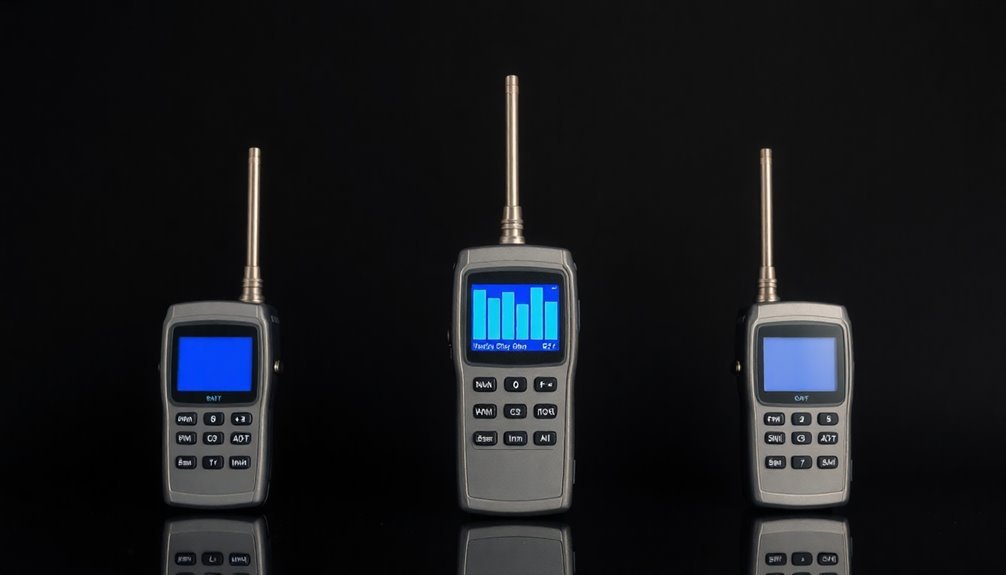
You'll find excellent value in three top field strength meters under $500. The Extech 480836 ($279) offers reliable 3-axis E-field measurements from 50-3500 MHz, perfect for basic RF detection. The Narda NBM-520 ($450) provides professional-grade coverage from 100 kHz to 60 GHz with NIST calibration options. The Safe and Sound Pro II delivers premium features like a 4-line OLED display and sound signature analysis at a mid-range price point. Each meter combines accuracy, portability, and user-friendly operation – but there's more to take into account when making your final choice.
Best Budget Field Meters
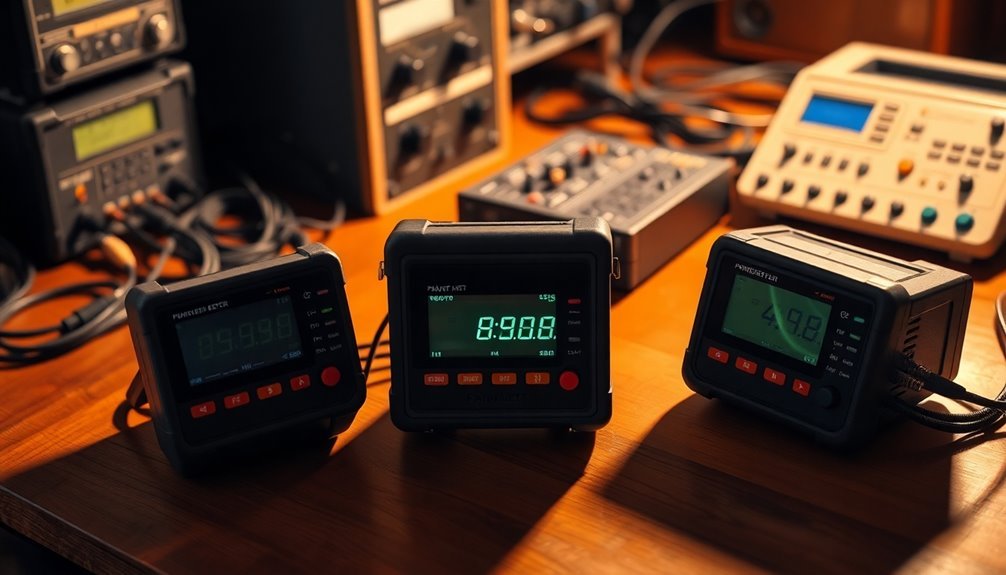
Budget field meters frequently offer surprising value for both DIY enthusiasts and professionals seeking reliable electromagnetic field measurements. You'll find excellent options like the Extech 480836, which provides 3-axis E-field measurements from 50-3500 MHz at just $279, or the Narda NBM-520, offering coverage from 100 kHz to 60 GHz at $450.
If you're technically inclined, you can build your own field meter using a simple FET circuit and basic components. These DIY versions can be quite effective, especially when you include features like gate leak resistors to prevent FET saturation. You'll be able to adjust sensitivity by modifying the antenna configuration. Components like the MPF102 JFET are commonly used in these projects due to their reliable RF detection capabilities.
For the best value in commercial units, look for meters that include auto-ranging capabilities and maintain calibration accuracy within +/-0.5 dB.
The Wavecontrol SMP3 and EMC Test Design RFP-05M stand out with their impressive specifications and battery life exceeding 20 hours. When selecting your meter, prioritize those with NIST or UK NPL traceable calibration certificates, clear displays, and both peak and RMS measurement capabilities. These features guarantee you're getting professional-grade functionality without breaking your budget.
Mid-Range Performance Options
Modern mid-range field strength meters pack impressive performance features while staying under the $500 mark. You'll find thorough measurement capabilities with dynamic ranges from +20 dBm down to -110 dBm, and accuracy within ±3 dB. These meters excel at both VHF and UHF measurements, covering frequencies from 20 MHz up to 3.5 GHz. Similar to simpler circuits, they utilize a charge pump circuit to efficiently measure and display signal strength.
| Feature | Benefit |
|---|---|
| CW/Pulse/Max-hold modes | Versatile signal type measurements |
| Fast log detector | Accurate GSM/digital signal capture |
| Triaxial measurement | Complete field strength analysis |
| 200 data set storage | Extended field documentation |
You'll appreciate the user-friendly interface with a 4½ digit LCD display that shows instantaneous, maximum, and average readings. The zero-center reference makes relative measurements straightforward, while the 10× scale multiplier lets you fine-tune your readings. For high-frequency work above 30 MHz, you'll need a 6 dB coaxial attenuator. Battery life won't be an issue with these units – you'll get about five hours between charges, and the auto power-off feature helps preserve battery life when you're not actively measuring.
Premium Features Under $500
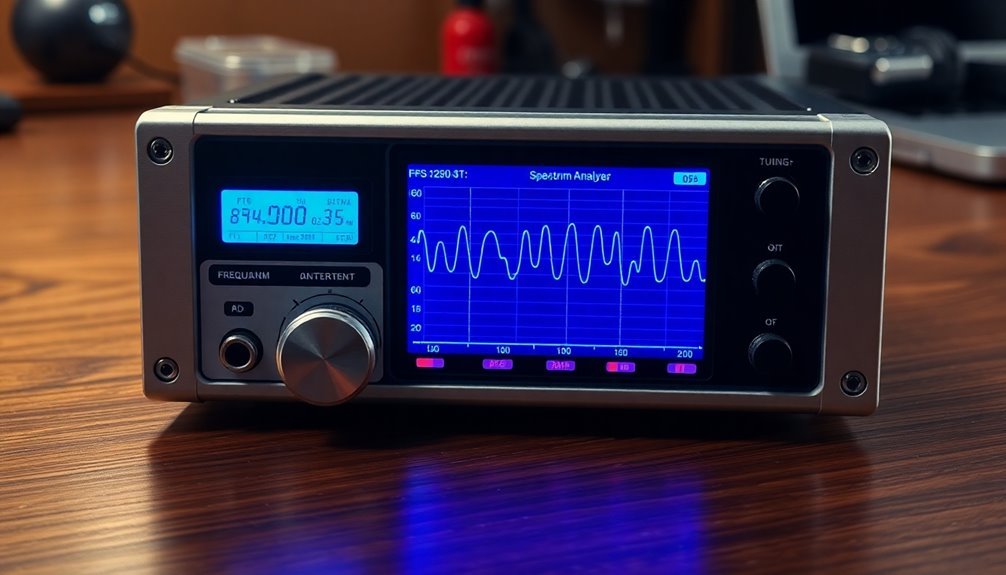
Several premium field strength meters under $500 pack impressive features that rival more expensive models.
The Safe and Sound Pro II RF Meter stands out with its premium 4-line OLED display, sound signature analysis, and three selectable volume levels. You'll also benefit from its third-party certification and individual calibration, backed by a 2-year warranty.
The TM-196 3-Axis RF Field Strength Meter offers extensive coverage with its 200 MHz to 8 GHz range and temperature compensation. Its 3-axis measurements guarantee you're getting accurate readings from multiple directions, making it ideal for thorough RF field analysis. Field strength meters provide relative readings rather than absolute measurements.
While not suited for high-frequency measurements, the Trifield Meter Model 100XE provides specialized features for lower frequency fields, including frequency weighting options and 3-axis magnetic and electric field measurements.
For specific applications, the Listen Technologies Field Strength Meter includes multiple operational modes and certification to IEC60118-4 standards, making it perfect for loop system performance testing.
The MFJ 802 works well for VHF frequencies, though it offers fewer premium features compared to the other options in this price range.
Frequently Asked Questions
How Long Does Field Strength Meter Calibration Typically Last?
Your field strength meter's calibration can last indefinitely if you protect it from environmental factors and don't modify components. However, you should perform regular verification checks to guarantee continued accuracy in measurements.
Can Field Strength Meters Detect Wi-Fi Signal Strength Accurately?
Yes, you can use field strength meters to measure Wi-Fi signal strength accurately in dBm. They'll detect the precise RF energy levels of Wi-Fi signals, giving you reliable readings within the typical -30 to -90 dBm range.
Do Weather Conditions Affect Field Strength Meter Readings?
Yes, weather conditions substantially affect your field strength meter readings. You'll notice temperature changes impact signal strength linearly, while humidity can cause fluctuations, especially below 0°C. Rain generally has minimal effect except when severe.
Are Smartphone-Based Field Strength Meter Apps Reliable Alternatives?
While smartphone apps can provide basic signal measurements, you'll find they're less reliable than dedicated meters. They offer convenience but lack precision due to hardware limitations and varying app quality across devices.
What's the Typical Lifespan of a Field Strength Meter?
You'll typically get 5-10 years from a well-maintained field strength meter. However, your device's lifespan depends heavily on usage patterns, maintenance routines, and environmental conditions you expose it to.
In Summary
Whether you're a hobbyist or professional, you'll find reliable field strength measurement without breaking the bank. Budget options like the TriField EMF-130 deliver basic functionality, while mid-range meters offer enhanced accuracy and digital displays. For the most demanding applications, premium models under $500 provide advanced features like data logging and PC connectivity. Choose based on your specific needs and measurement requirements.

Leave a Reply