
To prevent equipment damage, you'll need to maintain your data center's relative humidity between 45% and 55%. Install sensors every 3-9 meters along aisles to monitor humidity levels continuously, and set critical alerts for when RH reaches 40% or 60%. You should integrate humidity control with your precision cooling systems and use proper grounding solutions, including ESD flooring and anti-static materials. Regular HVAC maintenance and calibration are essential, especially during seasonal changes. Implement a Building Management System (BMS) for real-time monitoring and automated alerts. Our thorough guide shows you exactly how to execute these critical humidity control measures.
Understanding Data Center Humidity Basics

Effective humidity control consistently ranks among the most critical aspects of data center operations. You'll need to understand that humidity refers to the amount of water vapor in the air, with relative humidity (RH) measuring this as a percentage of the maximum amount air can hold at a specific temperature.
When you're managing a data center, you must maintain proper humidity levels to prevent two major risks. If your humidity is too high, you'll face problems with condensation, which can lead to corrosion and mold growth. The ideal environment maintains 45-55% relative humidity to ensure optimal equipment performance.
Conversely, if it's too low, you'll risk damage from static electricity and electrostatic discharge that can harm your electronic components.
You'll want to implement continuous monitoring using strategically placed sensors throughout your facility. Place them in racks, hot and cold aisles, and at various heights to get thorough data.
It's crucial to use temperature and humidity sensors together, as they provide the most accurate readings. You can enhance your monitoring capabilities by incorporating DCIM software, which offers real-time visibility and alerts when conditions fall outside acceptable ranges.
Optimal Humidity Range Settings
Setting precise humidity levels in your data center requires careful attention to established guidelines. You'll need to maintain relative humidity (RH) at 50% for ideal operations, while staying within the allowable range of 20% to 80%. ASHRAE recommends keeping ambient RH between 45% and 55% to guarantee peak equipment performance and longevity. Most modern data centers use monitoring systems to integrate with cooling solutions for automated humidity control.
| Humidity Level | Action Required | Impact |
|---|---|---|
| Below 30% | Urgent Alert | Static Risk |
| 40% | Warning Alert | Approaching Low |
| 50% | Ideal Range | Best Performance |
| Above 60% | Critical Alert | Condensation Risk |
You should configure your monitoring systems to issue alerts at specific thresholds. Set critical warnings for when RH reaches 40% or 60%, and important notifications at 30% and 70%. Keep the dew point temperature between -9 to 15 degrees Celsius to prevent condensation issues. For Class A1 to A4 equipment, you can operate within broader parameters of 8% to 90% RH, but it's best to stay within the recommended range to maximize equipment lifespan and minimize the risk of failures.
Static Electricity Prevention Methods
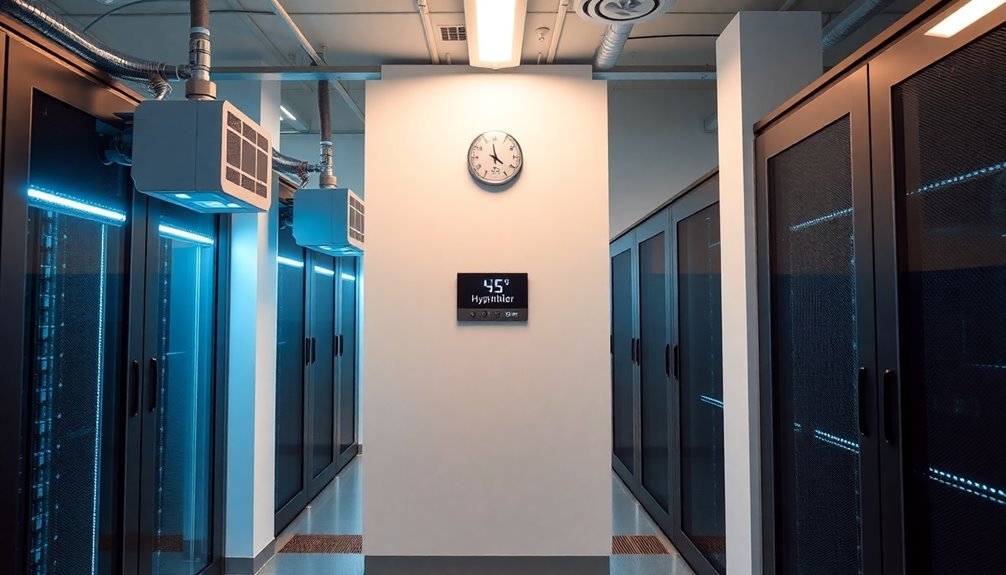
You'll need multiple layers of protection to effectively prevent static electricity in your data center, starting with properly maintained humidity control systems.
Modern data centers can operate safely with much wider humidity ranges while still protecting equipment from static damage.
Implement thorough grounding equipment, including wrist straps and heel grounders, to safely dissipate static charges from personnel and equipment.
Complement these measures with anti-static materials like ESD flooring and protective gear to create a complete static prevention strategy that protects your sensitive electronic equipment.
Humidity Control Systems
Data centers rely on multiple static electricity prevention methods to protect sensitive equipment and maintain efficient operations. You'll need to implement a thorough humidity control system that includes both monitoring and active management components.
You should maintain humidity levels according to ASHRAE's recommended range of 5.5°C dew point to 60% relative humidity. Install adiabatic humidifiers to efficiently add moisture to incoming air, especially in colder locations where the air tends to be drier. Place measurement sensors every 3-9 meters along aisles to ensure comprehensive monitoring.
It's essential to integrate these humidifiers with your precision cooling solutions for peak performance.
Set up multiple humidity sensors throughout your facility and connect them to an alarm system for continuous monitoring. You'll want to use hygrometers paired with temperature sensors to get a complete picture of your environmental conditions.
Take advantage of IoT capabilities to collect data and monitor conditions remotely.
Don't forget to review your humidity data regularly as part of your preventative maintenance routine. You should also work closely with cooling system manufacturers to identify the most effective monitoring solution for your specific facility.
This thorough approach will help prevent both high and low humidity-related issues.
Grounding Equipment Properly
To effectively prevent static electricity damage, proper grounding systems must form the foundation of your data center's ESD protection strategy. You'll need to implement thorough grounding solutions that include personnel protection and facility-wide measures.
Start by equipping your staff with essential grounding equipment. Make certain they're using wrist straps when working on stationary equipment, and provide ESD-safe footwear with heel grounders. ESD damage prevention is critical since even a small discharge of 10 volts can compromise sensitive electronic components.
Don't forget to supply ESD gloves, which not only prevent static buildup but also protect sensitive components from skin oils and contamination.
Install static-control flooring throughout your data center to create a continuous conductive pathway for static dissipation. You'll find that ESD tiles or anti-static floor paint can substantially reduce static generation. When combined with proper footwear, this creates an effective grounding system for mobile personnel.
Deploy benchtop and overhead ionizers in critical work areas to neutralize any remaining static electricity.
You should regularly maintain and calibrate all your static-control equipment to maintain consistent protection. Remember to monitor static levels continuously and train your staff thoroughly on proper ESD prevention methods, including the correct use of grounding straps and protective gear.
Anti-Static Material Solutions
Investing in anti-static flooring stands out as one of the most effective solutions for static electricity prevention in modern data centers. This seamless, smooth solution provides a safe path for static charges to dissipate while offering superior protection against equipment damage.
You'll find that ESD flooring is more effective than traditional humidity controls and allows your data center to operate across a wider range of temperature and humidity conditions. These systems maintain their static-resistant properties regardless of environmental changes.
- Withstands heavy equipment drops without cracking
- Provides chemical, water, and impact resistance
- Reduces humidification and energy requirements
- Prevents static buildup on personnel and equipment
- Offers significant cost savings compared to humidity control
You can implement anti-static solutions through ESD tiles, specialized floor paint, or anti-static mats in specific areas. When combined with static-control footwear, you'll create a thorough static prevention system that enhances equipment reliability and minimizes downtime.
The beauty of this approach lies in its dual benefit: you'll not only protect your sensitive electronic equipment but also reduce your energy consumption by decreasing the need for strict humidity control. Regular maintenance of these materials maintains consistent performance and long-term protection for your data center infrastructure.
Environmental Monitoring Systems
Environmental monitoring systems serve as the foundation for maintaining ideal data center humidity levels. You'll need to implement sensors strategically throughout your facility to track temperature, relative humidity, and airflow metrics in real-time. By integrating these systems with your DCIM software, you'll gain a thorough control over your environmental conditions. Regular sensor checks help create a centralized maintenance model that reduces the need for manual inspections.
| Monitoring Component | Key Function |
|---|---|
| Humidity Sensors | Track moisture levels to prevent equipment damage |
| Temperature Probes | Monitor heat distribution and HVAC efficiency |
| Airflow Meters | Measure air movement and ventilation effectiveness |
| Power Monitors | Track energy consumption and system performance |
You'll want to establish a CONOPS document that outlines response procedures for different sensor readings. Make sure your system includes customizable alerts and notifications to address issues before they become critical. Regular maintenance and calibration of your monitoring equipment are essential for accurate readings.
For precise control, you should integrate your HVAC systems with your monitoring tools. This integration allows for automated adjustments based on real-time data. You'll also benefit from multi-level access controls and individualized reporting settings, ensuring that your team can respond quickly to environmental changes while maintaining security protocols.
Humidity Sensor Placement Strategy

Proper placement of humidity sensors throughout your data center forms the cornerstone of effective environmental monitoring. You'll need to install sensors in both the front and back of racks to calculate Delta H, with at least one sensor covering every five racks. For precise accuracy, position sensors at the geometric center of air intakes across top, middle, and bottom equipment locations.
Mount your sensors strategically to capture thorough data across these critical areas:
- Hot and cold aisles at varying heights to detect airflow imbalances
- Near critical equipment zones requiring precise humidity control
- Wall-mounted positions 4-6 feet above the floor with unrestricted air circulation
- Center of ducts away from fans, corners, and HVAC components
- Protected outdoor locations away from heat sources and direct weather exposure
Don't forget to avoid areas with excessive moisture, fumes, or vibration that could compromise sensor accuracy. Regular monitoring helps achieve better cooling efficiency through optimized airflow and temperature regulation.
You'll want to calibrate your sensors annually and integrate them with your DCIM software for real-time monitoring. This systematic approach guarantees you maintain the ASHRAE-recommended humidity range of 20-80%, helping prevent both corrosion from high humidity and electrostatic discharge from low humidity conditions.
Common Humidity Control Mistakes
You're likely making critical humidity control errors if you're not regularly calibrating your sensors, as even small inaccuracies can lead to significant environmental management issues.
Failing to coordinate setpoints across different HVAC zones creates conflicting humidity levels that can damage your equipment and waste energy.
Your oversight of hot spot zones, particularly in high-density rack areas, can create microclimates with dangerous humidity variations that fall outside ASHRAE's recommended parameters.
Neglecting Regular Sensor Calibration
Regular sensor calibration stands as one of the most overlooked yet critical aspects of data center humidity control. When you neglect this vital maintenance task, you're risking equipment failure, increased energy costs, and potential damage to your facility's reputation.
Your humidity sensors gradually lose accuracy over time, leading to readings that don't reflect actual conditions in your data center.
The impact of poor calibration can be severe and far-reaching:
- Your equipment may fail due to undetected condensation or static electricity issues
- You'll likely face higher energy costs from inefficient cooling and humidification systems
- Metal components can corrode under uncontrolled high humidity conditions
- You risk non-compliance with industry standards and regulations
- Your maintenance costs will increase due to premature equipment wear
To maintain accurate humidity control, you'll need to implement a robust calibration process using certified equipment and humidity generators. Compare your sensor readings with reference measurements regularly, and verify your calibration team is properly trained.
Don't forget to maintain detailed calibration records for compliance purposes. By prioritizing regular sensor calibration, you'll protect your equipment, maintain efficient performance, and avoid costly downtime.
Improper Setpoint Coordination
Setting up coordinated humidity control points across your data center's CRAC units stands out as a critical challenge in environmental management. When you don't properly coordinate setpoints, you'll face demand fighting between units and unwanted fluctuations in room conditions.
Your CRAC units must work together, not against each other.
To prevent these issues, you'll need to group your CRAC units and synchronize their operation. Set consistent temperature and humidity points across all units within the same zone. Remember to maintain humidity levels within the ASHRAE recommended range of 45-55% RH, which represents your ideal "Goldilocks Zone."
Configure your early warning alerts at 40% and 60% RH, with critical alerts at 30% and 70% RH.
You'll want to guarantee that units within specific zones operate as a coordinated team. Don't let two units compete during the same interval unless they're assigned to different groups. By maintaining consistency across all CRAC units, you'll create stable environmental conditions throughout your data center.
This coordinated approach helps protect your equipment while optimizing system performance and longevity.
Overlooking Hot Spot Zones
Data center's hot spot zones pose significant risks when overlooked in your humidity control strategy. These areas, typically found near high-density server racks or spots with poor air circulation, can create condensation that damages your electronic components.
You'll need to implement strategic monitoring and solutions to protect your equipment from humidity-related failures.
- Place temperature and humidity sensors every 3-9m of aisle or at every fourth rack position
- Maintain relative humidity between 45% and 55% for ideal equipment performance
- Test for corrosion levels twice yearly, especially in environments with Cl2 or H2S
- Use thermal imaging cameras to detect hidden inefficiencies
- Position HVAC units strategically to maximize airflow distribution
To effectively manage hot spots, adjust your air handler setpoints and modify floor gratings for better air distribution. You can improve circulation by removing glass doors from racks and repositioning floor vents.
Remember, your IT equipment might tolerate humidity variations better than expected, but proper control remains vital. Consider switching to a return air to supply air control strategy for consistent temperature and humidity levels.
Regular maintenance of your HVAC systems, combined with strategic monitoring, will help you prevent equipment damage and maintain efficient operating conditions.
Energy-Efficient Humidity Management
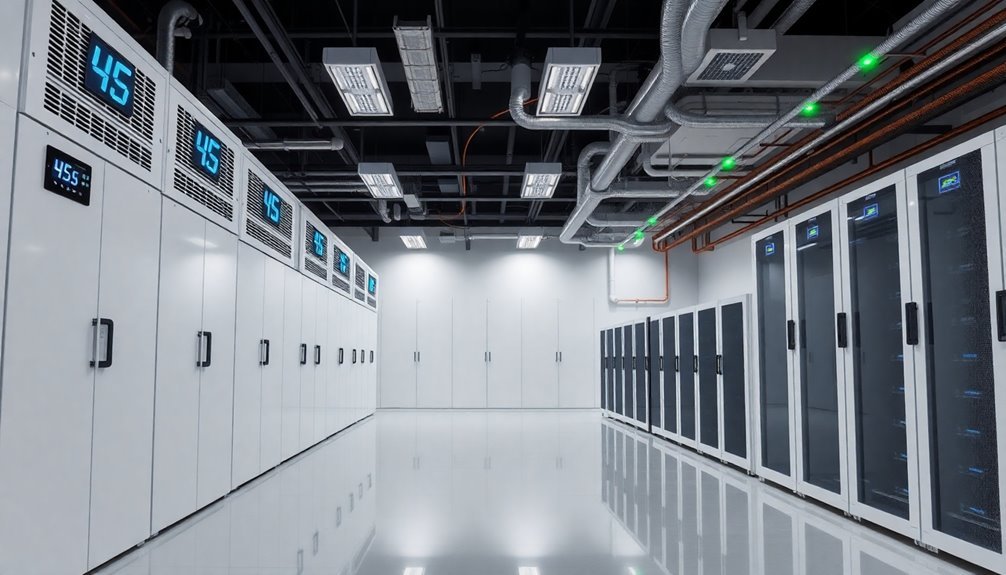
Managing humidity levels efficiently in data centers requires a multi-faceted approach that combines smart technology with strategic system adjustments. You'll need to implement energy-efficient solutions while maintaining ideal conditions for your equipment.
Start by installing adiabatic evaporative humidification systems and leveraging IoT devices for real-time monitoring. You can optimize your control by switching from relative humidity to dew point monitoring, keeping the dew point between 5.5°C and 15°C. Reduce your fresh air supply to minimize pressurization needs and energy consumption.
| System Component | Energy-Efficient Action | Benefit |
|---|---|---|
| HVAC Units | Use AI-driven controls | Automated adjustments |
| Sensors | Install smart IoT devices | Real-time monitoring |
| Software | Implement DCIM with ASHRAE charts | Precise threshold control |
Don't forget to maintain your equipment regularly. You'll need to schedule periodic inspections of humidification systems, replace filters, and calibrate monitoring devices. Train your maintenance staff to spot early warning signs and use diagnostic tools like thermal imaging cameras. By incorporating these practices, you'll create an energy-efficient humidity management system that protects your equipment while reducing operational costs.
Emergency Response Protocols
A well-structured emergency response protocol forms your critical defense against humidity-related crises in the data center. You'll need to implement thorough monitoring systems and clear response procedures to protect your critical infrastructure.
Your Building Management System (BMS) should be configured to alert your Critical Environments team when humidity levels reach concerning thresholds, with early warnings at 40% and 60% relative humidity, and critical alerts at 30% and 70%.
Key elements of your emergency response protocol should include:
- Detailed step-by-step procedures for immediate corrective actions
- Clear communication chains and escalation pathways
- Regular staff training and emergency response drills
- Specific contingency measures for equipment protection
- Documentation of all incidents and response effectiveness
You'll need to guarantee your team can quickly adjust humidification systems and modify HVAC operations when alerts occur. Train your staff to perform immediate corrective actions, including adjusting dehumidifiers, modifying air handling units, and implementing emergency procedures.
Regular maintenance checks and sensor calibration will support your emergency response capabilities, while documented procedures guarantee consistent execution during critical situations.
Keep your emergency protocols updated and conduct periodic reviews to maintain effectiveness.
Seasonal Humidity Challenges

You'll need distinct strategies to manage your data center's humidity as seasons change throughout the year, with summer requiring aggressive dehumidification controls and winter demanding careful humidification to prevent ESD issues.
During periodical changes like spring and fall, you're looking at flexible response plans that can quickly adapt to variable weather patterns and maintain ideal humidity levels.
Your success depends on implementing season-specific protocols that include strategic sensor placement, proactive system maintenance, and continuous monitoring of both dew point and dry bulb temperatures.
Summer Heat Impact Strategies
Summer's intense heat poses unique challenges for data center operators, particularly when it comes to managing humidity levels. You'll need to implement robust strategies to protect your equipment from moisture-related damage and maintain ideal operational conditions.
When humidity levels climb above 60%, you're facing increased risks of condensation, rust formation, and potential short circuits that can damage critical hardware components.
- Monitor humidity levels continuously using strategically placed sensors
- Install dehumidification systems appropriate for your climate zone
- Maintain HVAC systems regularly to prevent efficiency loss
- Implement real-time monitoring and alert systems
- Use advanced diagnostic tools like thermal imaging cameras
To protect your data center effectively, you'll need to integrate these monitoring and control systems with your existing HVAC infrastructure. Place humidity sensors every 3-9 meters along aisles or at every fourth rack position to guarantee thorough coverage.
Don't forget to work closely with cooling system manufacturers to select compatible monitoring solutions. By maintaining humidity levels between 45-55% as recommended by ASHRAE, you'll prevent equipment damage and extend the life of your hardware.
Remember to train your maintenance staff to recognize early warning signs and respond quickly to humidity alerts.
Winter Dry Air Solutions
During winter months, data centers face a distinct set of challenges as dry air and low humidity levels threaten equipment reliability. You'll need to implement specific strategies to maintain the ideal relative humidity range of 45-55% RH to protect your equipment and prevent static electricity risks.
Start by calibrating your HVAC systems to accommodate winter conditions. You'll want to adjust heat rejection points to maximize efficiency during colder temperatures while implementing humidification systems to introduce necessary moisture.
Install high-quality sensors throughout your facility to monitor humidity levels accurately and verify you're maintaining the recommended range of 40-70% RH.
Don't forget to conduct regular maintenance on your humidifiers and HVAC systems to prevent inefficiencies. You can integrate IoT-enabled monitoring systems for real-time data collection and quick adjustments when humidity levels fall outside acceptable ranges.
This approach helps you prevent equipment damage while optimizing operational costs.
Transitional Weather Response Plans
Seasonal shifts pose unique challenges for data center humidity control, requiring thorough response plans to maintain ideal conditions. You'll need to adapt your humidity control strategies as weather patterns change, particularly during spring and fall when temperature and moisture levels can fluctuate dramatically.
Your HVAC systems must be recalibrated to handle these changes while maintaining the critical 40-70% relative humidity range.
- Monitor real-time humidity data to detect sudden changes
- Adjust HVAC settings proactively based on weather forecasts
- Inspect and maintain humidification systems before seasonal changes
- Position temperature and humidity sensors strategically throughout the facility
- Implement automated alerts for when conditions approach threshold limits
Your seasonal weather response plan should include regular system diagnostics using thermal imaging to identify potential trouble spots.
Keep your emergency protocols updated and guarantee your staff is trained to respond to rapid weather changes that could affect indoor conditions.
Don't forget to verify that your redundant HVAC systems are functioning properly before challenging weather periods begin.
Equipment Protection Best Practices
Protecting your data center equipment requires a thorough, multi-layered approach that combines physical security with environmental controls. You'll need to implement separate rooms for your data center and IT equipment to effectively isolate potential fire hazards and maintain strict environmental standards.
Start by using fire-resistant materials in your construction and openings, and install rack-level fire detection and suppression systems. Don't forget to integrate extensive fire alarms and sprinkler systems throughout your facility.
These systems should work together seamlessly with your environmental controls to maintain the best temperature and humidity levels.
To guarantee maximum protection, you'll want to implement redundant systems across your infrastructure. Install backup generators and UPS systems for reliable power, and maintain redundant network connectivity to prevent downtime.
Integrate your environmental monitoring systems with security measures like access control and surveillance for real-time alerts and rapid response capabilities. You should also use CCTV and sensor-based technology for continuous monitoring of your facility.
Remember to regularly test and maintain all these systems to guarantee they're functioning effectively and ready to respond when needed.
Humidity Control Cost Analysis
While implementing robust equipment protection measures safeguards your data center, managing humidity control costs can substantially impact your operational budget. You'll need to carefully evaluate your current systems and consider cost-effective alternatives that maintain ideal performance while reducing operational expenses.
- Ultrasonic humidifiers offer quick ROI (0.5-2 years) through significant energy savings
- Traditional steam systems increase both energy consumption and cooling loads
- Smart sensing technologies and IoT integration optimize control and reduce waste
- Regular maintenance prevents costly disasters and system inefficiencies
- Variable Speed Drives deliver payback within 1.6-2.6 years
You can reduce costs by implementing wider humidity ranges that still maintain IT performance standards. Consider adjusting your air handler setpoints to align with return air temperatures, meeting ASHRAE recommendations while minimizing energy usage.
You'll also save by reducing fresh air supply and using dew point temperatures to regulate dehumidification. Don't overlook the importance of staff training and periodic monitoring – these investments help identify potential issues before they become expensive problems.
Automated Alert Systems
Implementing automated alert systems provides essential safeguards for your data center's environmental controls. You'll benefit from real-time monitoring through user-friendly interfaces that integrate seamlessly with your existing DCIM systems.
These systems utilize wireless sensor networks and cloud-based analytics to deliver accurate, continuous monitoring of your facility's conditions.
You can customize alert thresholds using platforms like PRTG and SensGuard, which will notify you immediately when humidity levels fall outside acceptable ranges. The systems' IoT capabilities enable you to access monitoring data remotely, while internal memory in data gateways guarantees continuous operation even during Internet outages.
To maximize your system's effectiveness, you'll need to maintain regular calibration schedules and guarantee proper staff training. When selecting a system, consider your specific requirements, budget, and future scalability needs.
The benefits you'll gain include prevention of equipment damage, enhanced operational efficiency, and the ability to take proactive measures before environmental issues become critical. By integrating these systems with your existing HVAC infrastructure, you'll create a thorough monitoring solution that helps maintain ideal conditions throughout your data center.
Frequently Asked Questions
How Often Should Humidity Sensors Be Recalibrated for Optimal Performance?
You'll need to calibrate your humidity sensors at least once a year, but if you're using them in harsh environments or critical applications, you should increase the frequency of calibration checks.
Can High Humidity Levels Affect the Lifespan of Backup Tapes?
Yes, high humidity will substantially reduce your backup tapes' lifespan by causing binder breakdown, tape pack distortion, and potential fungal growth. You'll experience faster degradation and increased risk of data loss over time.
What Role Does Air Pressure Play in Maintaining Data Center Humidity?
You'll find that air pressure controls moisture levels by optimizing airflow and preventing external humid air infiltration. It helps your HVAC systems remove excess moisture while maintaining positive pressure throughout your data center space.
How Do Different Flooring Materials Impact Humidity Control Effectiveness?
Your flooring choice directly affects humidity control. Anti-static flooring helps maintain ideal levels, while hardwood can complicate humidity management. Laminate offers a middle ground, but you'll need proper monitoring for all options.
Should Humidity Settings Be Adjusted During Scheduled Maintenance Periods?
You'll want to adjust humidity settings during scheduled maintenance to minimize disruption. It's the ideal time to coordinate with operations teams and test equipment responses while monitoring through your DCIM system.
In Summary
You've learned that maintaining proper humidity control in your data center is essential for protecting valuable equipment and ensuring peak performance. By implementing monitoring systems, strategically placing sensors, and following best practices for humidity management, you'll prevent costly damage from static electricity and moisture-related issues. Regular assessment of your control systems and quick responses to automated alerts will keep your facility running smoothly year-round.